@Romer - this sounds like a class test problem.

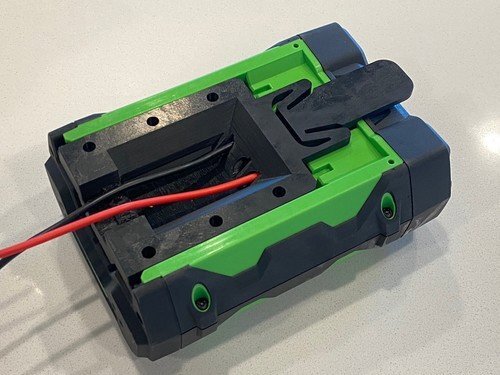
Best is to use a common unit in a situation like this, which are watts and watt-hours, to minimize conversion confusion. Power is power regardless of voltage, current and resistance/impedance.
Once you've converted all the component specs into power you can do your math straight across to get hours.
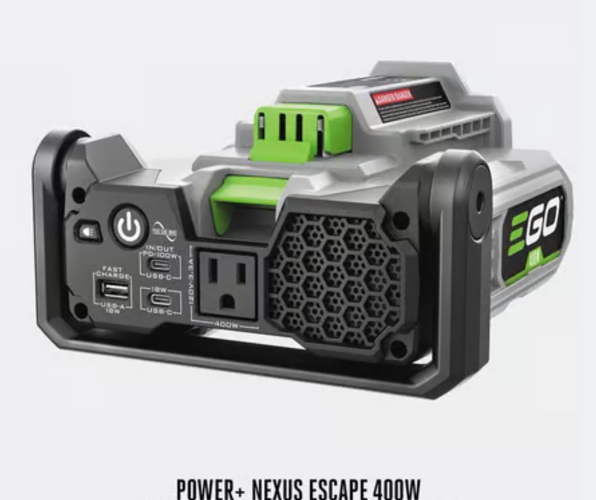
Where you'll need more data or testing is conversion loss. Inverters are lossy, even good ones. I would assume the 12V -> 120V to be no better than 80% by the EGO without specs or measurements. It's not specifically a knock on the device, just the nature of them.
For comparison in this size I have a Samlex SA-300-112, similar pure sine, 300W, etc. It's spec'd 89% efficiency and no-load of 0.24A, both of which I've found to be accurate.
I've done a little bit of testing running my Engel with it but nothing too rigorous at this point.
For example, approximate numbers. My MT45 fridge draws 34W running directly on 12V DC. The raw numbers measured by the battery shunt were 13.07V at 2.60A. The Engel compressor is natively 12V so this is a good number to have in our backpocket.
The inverter powered on, fridge unplugged the draw was 3W, that being 13.10V at 0.24A. This is the no-load inverter draw and matches the Samlex specification very well.
Fridge plugged in but dial turned OFF the draw increases to 6W, numbers being 13.10V at 0.46A. This appears to be the consumption of the SMPS inside the fridge that converts 120V to 12V.
The fridge running on 120V (thus battery -> inverter -> Engel 120V input) I measure 50W at the battery shunt. The actual numbers being 13.06V at 3.84A.
We know 34W of this is the fridge compressor and 3W is the Engel power supply. That means 50W - 37W = 13W was consumed in the inverter.
We can then infer that 3W (the no-load consumption) probably runs the inverter control circuit and 10W is the actual conversion loss. It's not unusual that at light load the efficiency will go down. In this case total inverter efficiency being about 74% (37W at 120V delivered for 50W drawn from 12V) at about 12% rated load (37W/300W).
It's unlikely you'll have this level of visibility into the EGO inverter but it gives you some idea how much power delivered 120V will cost from the battery. It's going to be significant losses.
You're right on with duty cycle, I regularly measure 35% duty cycle on my fridge at beer temps.
Regarding estimate of consumption, in my experience sitting closed and stable I get around 0.75 Ah/hr maintaining and when I put in new beer and am opening to take them out I go up to about 1 Ah/hr.
These are 12V numbers around 13.1V so talking 10 to 13 Wh/hr consumed at the ~35% duty cycle.
If you've read this far the take away is going to be that, with an Engel at least, you are better running at 12V by about 9% since there's a 3W penalty using the internal 120V to 12V power supply.
Secondarily from the battery side using an inverter is going to cost about 25% in my testing. Purely analytically the best case is a 11% loss using the Samlex 89% specification.
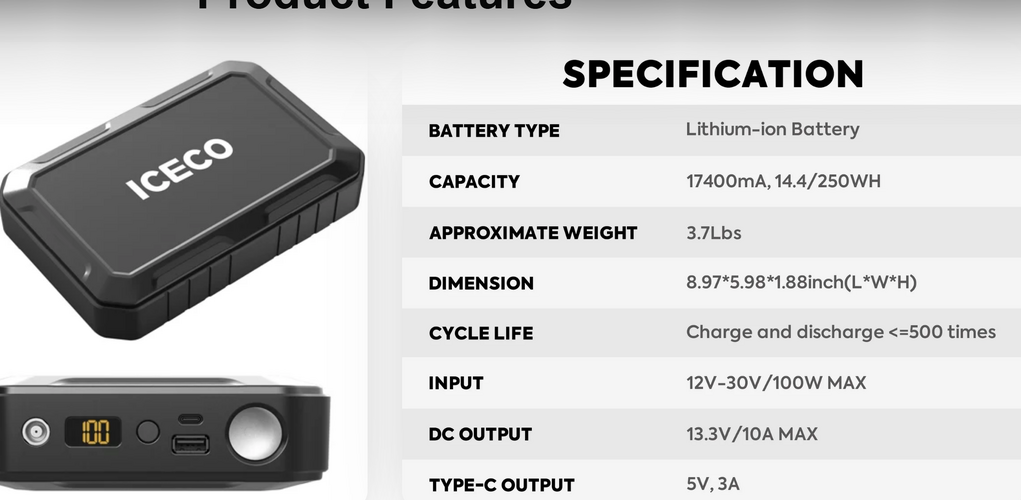
Now there is one additional possible loss. If you notice the ICECO battery spec is 14.4V at 17.4 Ah to give you 250 Wh. But it also tells you it has a 13.3V @ 10A maximum 12V output. This tells you there's a 4-cell battery inside (3.6V x 4 = 14.4V) that is running a converter or protection. It could just be a thermal fuse or thermistor, which would be low loss or might be an actual DC-DC converter. There could be some loss there, maybe a few percent. ICECO should calculate that into their capacity but might not. Just something to know if you find you're consistently getting 5% or 10% less time than 250 Wh would otherwise suggest.
Edit to add run time estimates.
So my battery is 74 Ah and at ~13V means 962 Wh.
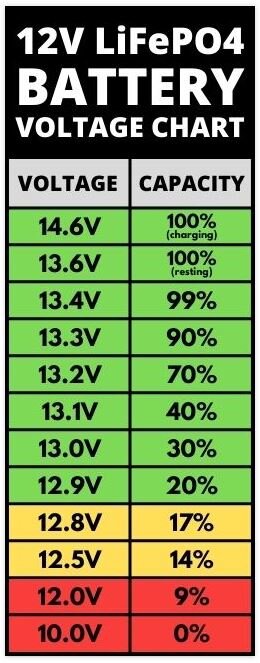
Let's say I don't want to run completely to zero so I have a voltage cutoff that represents 10% minimum state of charge. For round numbers that means I can use 850 Wh for a cycle.
Using the fridge on 12V that means I'll get 850 Wh / 13 Wh/hr = 65 hours in theory.
Using the inverter and fridge on 120V reduces this to about 44 hours.