• REGISTER FOR RISING SUN'S 2ND BEST EVENT: THE COLOYOTA EXPO. IT'S ONLY $5, DUDE.
    → No extra fee to bring yer extra stuff and sell it at the swap meet.
    → It's not Cruise Moab, but it's way cheaper and you can sleep in your own bed.
    Businesses: Still time to register your company to be an exhibitor at the event, too!
    Click here to register today..

Portable Fridge Power

DaveInDenver

Rising Sun Ham Guru
Joined
Jun 8, 2006
Messages
14,239
Location
Grand Junction
Yes, I'm an admitted Victron fanboy.
I've been real happy with my Orion 18A DC-DC so far. Victron does seem to be a top end brand in the segment. About the only question in my mind is it runs fairly hot at full tilt. Never hit shut down but the heat sink gets upper 40s, lower 50s °C, uncomfortable to touch.

I like my Morningstar solar controller a whole lot but the monitoring isn't nearly slick what Victron is doing. I first encountered them working, you see them pretty often in telecom and oil & gas (like the Tristar MPPT, but it's a $1,000 solar controller). They're bulletproof and powerful if you persist, though. You get complete visibility of the internal variables and can customize the algorithm however you want (like turning off float completely). But they don't make nearly the range of devices as Victron, pretty much just solar controllers and inverters, and assume you're putting your device on a network so probably developed a custom interface solution.
 
Last edited:

DaveInDenver

Rising Sun Ham Guru
Joined
Jun 8, 2006
Messages
14,239
Location
Grand Junction
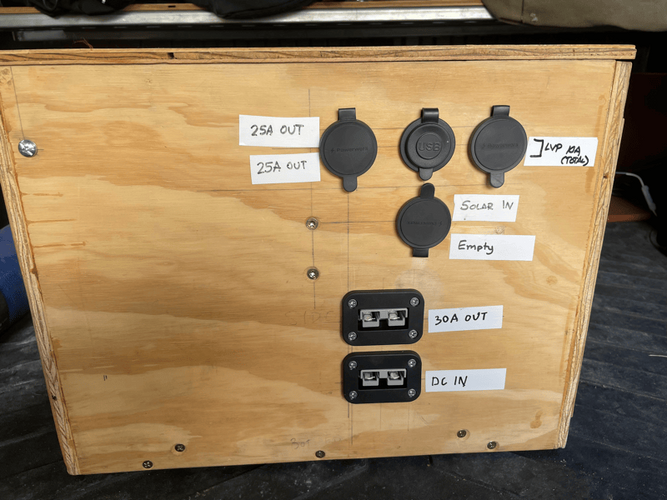
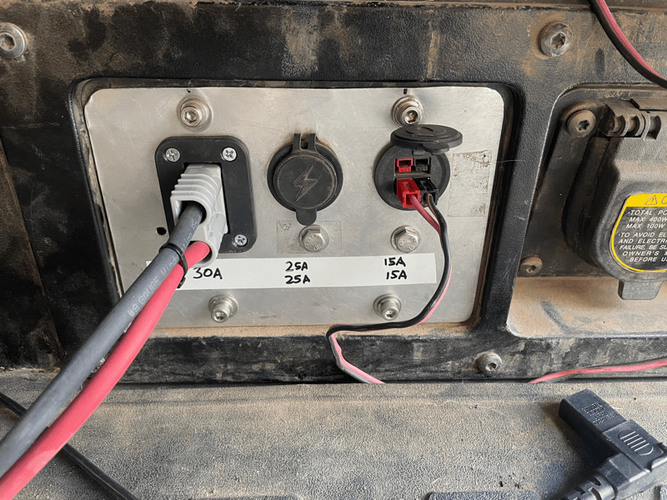
Upgraded up a few things in the chain so that there's nothing smaller than 8 AWG or SB50 from the truck battery to DC-DC all the way to the lithium batteries in the box.

Got the total voltage drop down to about 0.65V compared to what the truck charging reads at the input to the DC-DC with 18A of charging on the output (so full 220W it appears, about 5% total drop end-to-end). This is a significant improvement. Was getting around 1V to 1.25V drop since there were a few lengths of 10 AWG still in the circuit and I was using PP45. This was causing the DC-DC to current limit and the most I'd see is roughly 180W of charging.

Also added an SB50/30A output to the battery box to accommodate a 300W inverter I'm thinking about mounting. Just not sure where yet. Probably time to start thinking about Mk3 of this thing, which is to put the whole mess in something the looks less like ass. Or Mk2, rev. D, which is to paint it at least...

Stumbled into some 4 AWG marine wire that's duplex jacketed. The prospect of replacing the front-to-back run with it isn't high on when I think of a few of my favorite things.

IMG_5049_mid.png

IMG_5055_mid.png
 
Last edited:

LARGEONE

Rising Sun Member
Joined
Jun 12, 2007
Messages
3,293
Location
Broomfield, CO
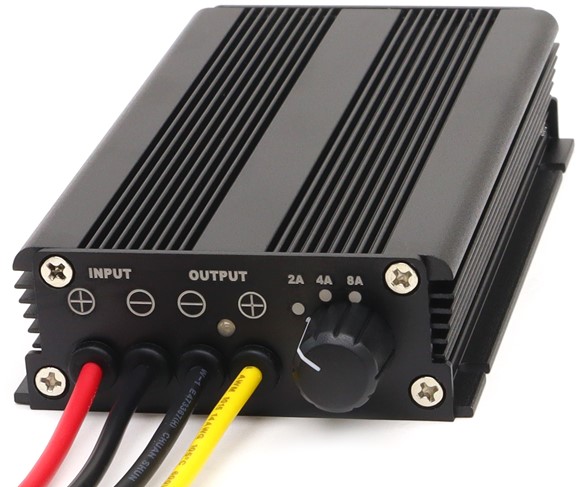
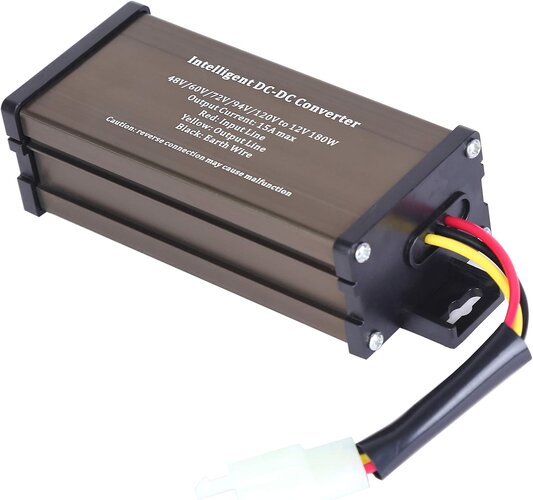
Timely post, Dave. I am doing the same with a 50AH lithium, except I just purchased this Powerworx DC to DC converter I'm going to try. The reviews also talk about it getting fairly hot when running at the 8amp setting. This allows me to use smaller wires than some of the larger converters. I have a 40amp converter that is just too large. I only want to be able to run my fridge and save my starting battery now that I'm no longer running a dual battery system. I have a 100W solar panel and a 10amp MPPT charge controller to help top off the 50AH LIFEPO4 when sitting. The only issue I see with this PowerWorx converter is it is not as "smart" as the Orion in that it only has the two charging methods...bulk amps and steady V. Not ideal, but it is not going to be pushing when I'm not driving so less of a concern for me.


DaveInDenver

Rising Sun Ham Guru
Joined
Jun 8, 2006
Messages
14,239
Location
Grand Junction
Yeah Paul, actually came across that charger recently.

I don't have one personally to tell for sure but it looks to me like the operation is two-step, bulk at current you select up to 14.5V, so essentially that's the absorption voltage, with red LED. When it reaches 14.5V it seems to turn off, the LED goes green.

If that's the case then it's strictly fine but quite a bit more aggressive than I'd like.

It does depend on exact chemistry but assuming you're using LiFePO4 (LFP) then 3.65V/cell = 14.6V is the absolute maximum you should charge to and that assumes a perfectly balanced battery. Fully charged LFP is 3.4V/cell = 13.6V or higher, so this is really testing the upper limit. There's not a lot of practical advantage to pushing this hard and even with a good condition battery with a balancing BMS the cells are going to vary at least a few mV. So the BMS is eventually just going to turn off all charging once one of the cells hits 3.65V.

One thing I would caution is to never use this charger with a battery that does not have a BMS in it. In general you should never use a lithium battery at all without a BMS but in this case at a voltage with very little margin the risk is considerable.
 
Last edited:

LARGEONE

Rising Sun Member
Joined
Jun 12, 2007
Messages
3,293
Location
Broomfield, CO
Thanks Dave! Appreciate the comments on this new converter. My 50AH is smart with low temp cutoff and BMS (as well as BlueTooth). My plan is to only use it sparingly as needed in the back country and rely more on my solar and home smart charger. I really just want to make sure that whenever I am sitting, that I am not using my starting battery at all.

Edit: I wish I could adjust the output V on this converter to something in the lower 14 or high 13s range
 

DaveInDenver

Rising Sun Ham Guru
Joined
Jun 8, 2006
Messages
14,239
Location
Grand Junction
Edit: I wish I could adjust the output V on this converter to something in the lower 14 or high 13s range
Agreed, 13.9V is the sweet spot I've settled on now that my cells are stabilizing.

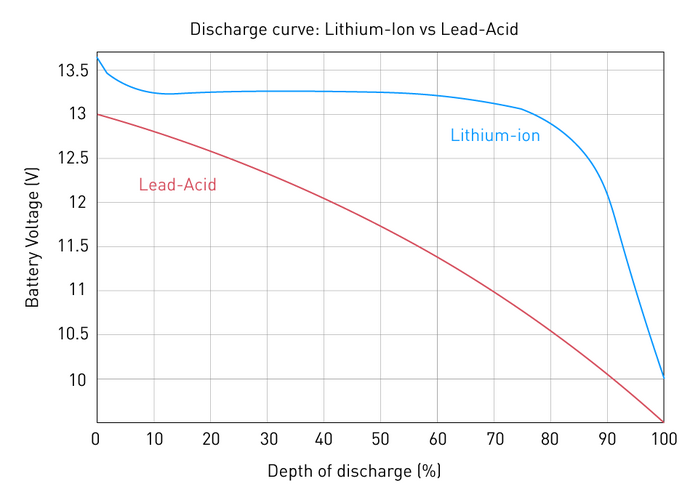
BTW, don't use voltage with lithium as an absolute reference, they don't have quite the same function for state of charge to voltage as lead-acid. The relationship that does exist is very tight, a voltage might not change for long periods and suddenly jump.

It's best to have a current meter and read amp-hours or watt-hours going in and out while watching ideally individual cell voltages as a secondary data point. Voltage is easier to use for control and certainly as triggers for safety.
 

LARGEONE

Rising Sun Member
Joined
Jun 12, 2007
Messages
3,293
Location
Broomfield, CO
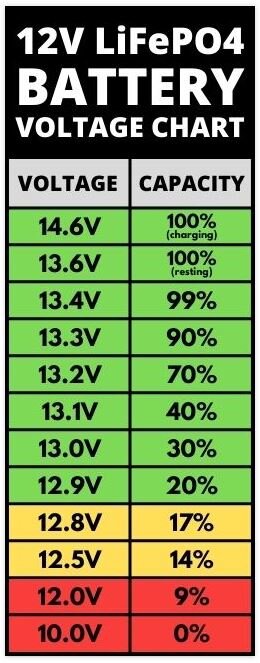
I typically use voltage, but just as a close proxy for state of charge. I don't really have another easy way for the current or AH draw. When I get below 13V I charge :) I know this isn't perfect, but for how many charge cycles this will see, I think I will be OK.
LiFePo4 charge.JPG
 

DaveInDenver

Rising Sun Ham Guru
Joined
Jun 8, 2006
Messages
14,239
Location
Grand Junction
I didn't mean to imply otherwise @LARGEONE. I only meant as a general rule not to trust voltage on lithium the same way as you can with lead-acid.

The chart you show is right on but a graph to visualize how narrow the voltage difference between 100%, 80%, 20% and 0% is between the two types. You want to stay between 20% and 80% on lithium for long life and safety but the high/low change is on the order of 0.25V across this working region while on a lead deep cycle you'd have 2V of room to voltage change to work with over that range.

BMS_Chapter_1_Fig7-_960_x_688.png

The point I failed to make is when you have this narrow margin of error your meter quality comes into play as to how much you're sure you're staying between the ditches.

For example a 3-3/4 digit DMM might specify a 0.1mV to 100mV resolution depending on range and 0.5% + 4 counts accuracy.

This means if it has a 40V range it can show 04.00V to 39.99V, thus the resolution is 10mV per step. When displaying 13.10V the 0.5% accuracy will means the measurement could be as much as 0.0655V in error plus the 0.01V resolution plus 4 counts of the least significant digit.

So that means when the voltage is 13.10V the DMM could show as low as 12.99V up to 13.22V and be within it's specifications. It's probably better than this (likely close to 13.03V to 13.18V) but you don't know. In any case this amount of uncertainty is only enough to give you an estimate within about +/- 25% as to state of charge across the plateau.

Using 13V as the re-charge point is safe in the sense you'll never risk dropping off the cliff below 20% but you might not end up using a lot of capacity if it's really closer to the 45% state of charge when you think it's at your 20% floor.

On the charging side this theoretical DMM is good enough to make sure you don't go too high (this being above 14.6V) as long as you stop at around 14.45V.

On lead-acid using a DMM to judge state of charge based on DMM voltage you're able to estimate within a couple of percent because the SOC-vs-voltage response is so much larger and linear.

There's not much you can do about meter accuracy, even calibrated it is what it is based on what you're willing to spend. So if you want to really know it's considerably cheaper to get an accurate enough (because 1% is fine due to the larger changes in magnitude and time averaging) current meter than it is a better voltage meter in this situation. To further complicate the question a cheap DMM is often still quite a bit better than your typical panel mounted volt meter, which may only be full unit accuracy (+/- 2% is not unusual), so showing 13.1V could very plausibly be as much as 0.25V in error and that's enough you could be at 20% and think you're at 80% or vice versa. To some extent you can calibrate by comparing to a known good measurement but the offset may not be consistent, such as the error may drift with temperature.

It's totally a question of what you need, though. Warm beer in a fridge on a weekend trip is not a problem vs living full time off grid losing a fridge of food that could be a real problem vs running medical equipment where it's critical.
 
Last edited:

LARGEONE

Rising Sun Member
Joined
Jun 12, 2007
Messages
3,293
Location
Broomfield, CO
Thanks for the additional info. It is amazing how flat the voltage stays on LiFePo4 through the 80 down to 20ish. Love these batteries!
 

rover67

Rising Sun Member
Joined
Nov 1, 2007
Messages
9,726
Location
Boulder, Co
Great conversation here. I’m still stuck in the 2010’s with the 80 dual lead/acid batt setup but the camper has a ~300ah LiFePo battery in it and I’m looking to upgrade to DC-DC charging rather than the straight to starting battery wire. I’ll say that for the camper moving away from lead acid was pretty amazing.
 

DaveInDenver

Rising Sun Ham Guru
Joined
Jun 8, 2006
Messages
14,239
Location
Grand Junction
upgrade to DC-DC charging rather than the straight to starting battery wire
It's a highly worthwhile thing to do. For all types it decouples so the house doesn't end up trickle charging or worse if you were solar charging in camp preventing it feeding back into the truck and drawing it down. With lithium there's the added peace of mind that charging voltage sits in the right spot and you're aren't relying on the BMS as your only voltage protection or that you try to charge a cold battery. That last thing is something I have to deal with since I have not yet put any heating into my battery so I can't let it try to charge below about 35°F and my charger is smart enough not to try even tho the BMS will also block it from happening.
 
Back
Top