Lets discuss off road recovery gear

nakman

Rising Sun Member
Staff member
Joined
Aug 23, 2005
Messages
15,495
Location
north side
yeah that's what I was initially thinking Ken, but in my head those seem like they're only for steel cable? Or maybe the rope stays put if you crimp it enough. But now I'm learning about knots and duct tape... and of course I already ordered Corbet's thing. :rolleyes:
 

Romer

Moderator
Staff member
Joined
Aug 22, 2005
Messages
10,587
Location
Centennial, Colorado
yeah that's what I was initially thinking Ken, but in my head those seem like they're only for steel cable? Or maybe the rope stays put if you crimp it enough. But now I'm learning about knots and duct tape... and of course I already ordered Corbet's thing. :rolleyes:
I am sure that will work as well

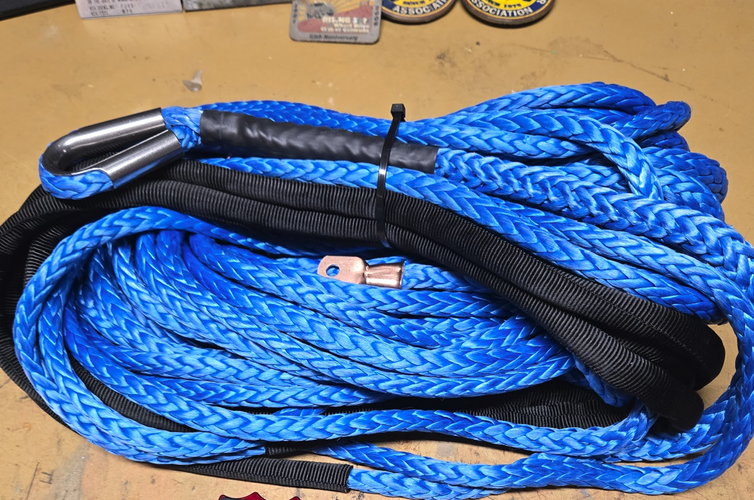
My amsteel Blue line came like this

1769055586093.png
 

Inukshuk

Rising Sun Member
Joined
Aug 24, 2005
Messages
8,426
Location
Denver, CO
hey what do you call the metal end that goes over a synthetic winch line? It's like a 2ga wire terminal... the thing that bolts to a winch drum.
Trash. I call it trash.

Corbet's thing is ok.

Jackson's method is BEST. I would be happy to meet with you and show you.
 

Inukshuk

Rising Sun Member
Joined
Aug 24, 2005
Messages
8,426
Location
Denver, CO
The fact that winch rope manufacturer's use the metal bit is simply because its cheap.
In ALL situations the friction of the 7-11 drum wraps you ALWAYS leave on the drum with synthetic line are actually what holds the load.
The metal will separate from the line under any modest load.

The constrictor knot WILL hold the entire load on your winch.

I can give many reasons. Lets take one that should be all you need to hear: You get a runaway load. Everything other than a constrictor knot will go whipping off the drum. Only the constrictor knot will keep the rope attached to the drum. The constrictor knot holds the entire load with minimal de-rate.

I recommend you return the Grabber.
 

On the RX

Rising Sun Member
Joined
Nov 19, 2016
Messages
2,283
Location
Superior
If going the tape method, I would suggest gaffers tape over duct tape. In fact, I would suggest gaffers tape over duct tape 99 times out if 100 uses. Duct tape is great for projects where you need to tape it, and then when you remove the tape, you still want that adhesive residue to hang out long after the tape is tossed.
 

BritKLR

Vice Commander
Joined
Oct 29, 2012
Messages
2,104
Location
ATC HQ - Nederland, Colo.
Running a length of rope along the drum, duct taping it, and spooling over the top is a long time tried and true method that is free and doesn’t have a metal screw head that chafes the rope in the same spot every time you spool in.

The safe extract method is good to unless you have a warn with sheathing, it gets super bulky. It’s kind of bulky with just line and no sheathing.

Sheathing is really only recommended on internal drum brake winches. It doesn’t hurt to have it on other winches, it’s just unnecessary
I like this a lot! Will be redoing mine this weekend after rescuing the PlowPig55 with the 8274.IMG_6797.jpeg
 

Corbet

Moderator
Staff member
Joined
Oct 24, 2006
Messages
9,884
Location
Durango, Colorado
@nakman I’ve never run the sheath stuff over my rope at the drum. I’m on an internal brake winch which I’m sure most of us are. I rarely ever power out. That is where the heat really gets generated especially if loaded. My 10 year old rope didn’t look like it was damaged by heat at the drum at removal. I’m sure Daniel @Inukshuk will comment and he may have a different opinion based on his higher level of training.

I had some at the hook end to protect it from abrasion during recoveries. On my recent respool I skipped it all together. I found always having it on the line was more inconvenient most of the time verse dealing with abrasion other ways. My winch gets used much more often for winter recoveries than summer. The sleeve thing would freeze up and just become a mess.

 
Last edited:

jps8460

Cruise Moab Committee
Joined
Feb 15, 2013
Messages
3,226
Location
Grand Junction
@nakman I’ve never run the sheath stuff over my rope at the drum. I’m on an internal brake winch which I’m sure most of us are. I rarely ever power out. That is where the heat really gets generated especially if loaded. My 10 year old rope didn’t look like it was damaged by heat at the drum at removal. I’m sure Daniel @Inukshuk will comment and he may have a different opinion based on his higher level of training.

I had some at the hook end to protect it from abrasion during recoveries. On my recent response I skipped it all together. I found always having it on the line was more inconvenient most of the time verse dealing with abrasion other ways. My winch gets used much more often for winter recoveries than summer. The sleeve thing would freeze up and just become a mess.
Not powering out is key for heat build up and brake longevity. Some winches hate being free spooled, especially in winter.
 

Inukshuk

Rising Sun Member
Joined
Aug 24, 2005
Messages
8,426
Location
Denver, CO
I have a superwinch talon 12.5. it’s gearbox makes for a very hard freespool pull. Bill Burke has advised me to do a little bit of powering out to warm up the grease and make it easier to freespool.

@Corbet 🙄🤩😎 I did many things differently prior to training. It wasn’t terrible. Nobody died. When we did that group buy years ago on Amsel blue I put some sheathing on the line. I have since removed it all. I use a piece of removable with Velcro abrasion guard for the soft loop at the end (I don’t run a hook, but I might go back to a hook or some other termination eventually). And I have a piece of removable abrasion guard in my tool kit. I can put anywhere on the line if needed.

I don’t know anybody who’s done any testing, but I can’t see how thin polyester or nylon over a rope that is tightly wrapped against the drum is going to make a massive difference on heat. Now, if it was made of asbestos, maybe!

Conceptually the idea of not using these little metal nubbins is that all they do is lightly hold the end of the rope in place while you make the initial wraps. The friction of the initial wraps holds the load.

That little nub can damage where the rope rubs against it. I have seen it.

When I first converted my winch from wire rope to synthetic, I wasn’t able to thread it into the hole on the drum and use a set screw so I used the tape method Jackson describes.

Another reason to use a constrictor knot: I’m down in a ravine hooking up to somebody else’s truck who got stuck. Because it’s such a difficult climb I asked the other dude who I just met on the trail to be by my truck and freespool the winch while we set it up. I’m tired and old he’s a bodybuilder so I ask him to free spool my winch and save me the effort. After all, he’s the one who his truck is stuck. While I’m down there, he’s free spooling and doesn’t count real good to stop at 7 to 11 wraps and goes all the way to the end with his big muscles. He is not able to pull my line off the spool.
 

Inukshuk

Rising Sun Member
Joined
Aug 24, 2005
Messages
8,426
Location
Denver, CO
I watched the Bubba Rope Grabber video and now am anti Grabber.
  • There is no way to get the first few wraps tight. The Bubba Rope Grabber video instructs to install the rope commencing at the loop more towards the center of the drum than the outboard loop. You're supposed to slide the rope through that loop, leaving enough so you can wrap it around the drum approximately five times and put it into the loop that is at the edge of the drum. You're simply not going to be able to get those first few wraps tight.
  • The grabber is going to spin on the drum the first time you tension it. It does not stay where you put it. As the center loop holes pull first it's probably going to twist and put a lot of tension on the grabber. Is the grabber rated for the kind of load you can put on your winch rope. Is it rated at all?
  • With nothing holding those first few wraps tight at all. They're useless. In other methods the first few wraps are functional.
  • The video says that you're relying on the wrap over those first wraps to hold. That translates into: "Do not unwrap to the first layer of your drum." You lose ~10% of your winch strength not going down to the first layer.
  • The guy has his hand on the winch drum as he's starting to spool in. It would take only a second for something to catch his hand and goodbye fingers. It's dangerous to have your hand close to, let alone on the drum, when you're powering the drum. I don't want to see a poor practice in a video that's designed to sell me a product that's supposed to be great.
It bears repeating that friction is what causes the rope to stay on the drum. It squeezes enough that in the early days synthetic rope was crushing drums from the squeezing force. Sometimes still does. Static friction doesn't generate heat. Static friction is improved by the tape. We know this from looking at the condition of the tape when the line is removed. It stays intact. Safe Xtract recommends Gorilla Tape. Gaffer's tape is similarly durable. Duct tape varies greatly. A very good high quality duct tape might be adequate. It's simply that a bit of sticky stuff from the tape is better than a smooth steel drum. Laying the tail across the drum and then wrapping over it with tape on the drum provides the resistance to keep the rope on the drum.

Once you've seen a constrictor knot, it all makes sense. The potential downsides are:
  • The bulkiness Jackson mentions and the difficulty if your rope has sheath on the end.
  • To get it off your drum if the knot has tension you are going to have to cut at the knot and lose a couple of feet of winch line. If you follow the practice of never going below approximately seven to 11 wraps of the drum you may never put strain on that constrictor knot.
  • It can be a real pain in the ass to tie a knot if you don't have good winch access.
 

Corbet

Moderator
Staff member
Joined
Oct 24, 2006
Messages
9,884
Location
Durango, Colorado
I had those very concerns with the Grabber when installing and spent some time at length making things as tight as possible. I never watched the video so I doubt my technique duplicated theirs. I did this a few years back and honestly don't even remember how I did it. Good chance there could be some duct tape in there somewhere.

If I were to do it again I'd follow Daniels lead with the knot. I'll edit my post above.
 

Romer

Moderator
Staff member
Joined
Aug 22, 2005
Messages
10,587
Location
Centennial, Colorado
Great discusssion. Something to keep in mind in the future!
 

DouglasVB

Rising Sun Member
Joined
May 5, 2015
Messages
2,387
Location
People's Soviet Socialist Republic of California,
Since we're talking about synthetic line, what is the current recommended method/approach for the end of the line that connects to an anchor or another vehicle? My winch line has an eyelet on the end and at times I've run a hook or a thimble. Currently it's just the eyelet. I am mostly using soft shackles now but I also still have metal shackles in my kit.

I noticed the other day that there's a little abrasion on the winch line around the eyelet where it rubbed against the ground when I dug my front bumper into some terrain due to its poor approach angle. So I know I need to cut that part out.

Is it best to put the eyelet back or is there something better?

What is the best way for me to splice the line at home and that tools do I need to buy to do it?
 

nakman

Rising Sun Member
Staff member
Joined
Aug 23, 2005
Messages
15,495
Location
north side
I like the eyelet personally as it has a wide range of applications. Rarely would I use a "hook," seems I'm always bow shackling evertying.

And look back a page, the Fid thing from Factor55 is what allows you to replace that eyelet... affectionately referred to as the pokey thing.
 

Corbet

Moderator
Staff member
Joined
Oct 24, 2006
Messages
9,884
Location
Durango, Colorado
This is still pretty much an individual’s choice IMHO. They all work, each have an advantage & disadvantage. I still run a hook without complaint. I end up doing more solo recoveries than anything and I just hook both eyelets of my tree saver without any other hardware. (I have a larger hook than comes with most winches)
 

rover67

Rising Sun Member
Joined
Nov 1, 2007
Messages
9,702
Location
Boulder, Co
You can use a pen or anything pokey and some masking tape and kitchen shears. I use the scissors we use to cut pizza with. And I usually find one of my daughters pens.
 

Inukshuk

Rising Sun Member
Joined
Aug 24, 2005
Messages
8,426
Location
Denver, CO
"eyelet"
Since we're talking about synthetic line, what is the current recommended method/approach for the end of the line that connects to an anchor or another vehicle? My winch line has an eyelet on the end and at times I've run a hook or a thimble. Currently it's just the eyelet. I am mostly using soft shackles now but I also still have metal shackles in my kit.

I noticed the other day that there's a little abrasion on the winch line around the eyelet where it rubbed against the ground when I dug my front bumper into some terrain due to its poor approach angle. So I know I need to cut that part out.

Is it best to put the eyelet back or is there something better?

What is the best way for me to splice the line at home and that tools do I need to buy to do it?
"AI Overview: An eyelet is a small metal ring used to reinforce a hole in fabric or leather, primarily for drawstrings or lacing. A thimble is a U-shaped metal reinforcement inserted into a loop of wire rope to protect it from crushing, chafing, and bending stress"

1769183043454.jpeg

Here is what I learned just now: Eyelet is round. Thimble is U-shaped.
(This is why I will say "throw me a soft shackle" and "hand me a screw pin bow shackle" and I avoid "throw me a shackle")

Presuming you have a thimble on the working end of you winch rope, that's fine. Primary concern there is crush. Pictured here does not have a gusset. They can crush in a hard pull. Then maybe you cannot get the screw-pin-bow-shackle pin through (or out). Also often thimble holes are too small for screw pin bow shackles. On the other hand, they protect the inside of the loop from abrasion and keep a good bend radius. Lesser concern is it getting jammed in the fairlead when you stow the rope.

Safe-Xtract, ASR, and others use dipped loops which address many concerns. I run a soft loop (just rope) with velcro-removeable abrasion guard and it stows behind a simple (Smittybuilt from Amazon) fairlead-clip-on license pate holder. PRO: I can easily check the condition of the loop. It is UV, dirt, and light-impact protected. If it gets sucked through the fairlead it harmlessly spins and is easy to retrieve. Its big enough for any attachment type. CON: Must monitor abrasion protection; Smaller bend radius (especially on a soft shackle).
 
Back
Top