Wheel weight effects on MPG

Corbet

Moderator
Staff member
Joined
Oct 24, 2006
Messages
10,571
Location
Durango, Colorado
I’m in need of a 2nd set of wheels for the 250-Series and choices are super slim if I want to keep the tire inside the wheel well, which I very much do. Factory offset is something like +60mm. I’ll take a little extra stance out to +40mm. In comparison my 80-series wheel offset is -12mm and that keeps my 37’s still inside the flares.

Google searching seems to put the OEM 250 wheel at 31lbs. I need to drop my spare and weigh it. If I assume the tire weight is to spec maybe I can confirm. The larger snow tires I’ve installed weigh about 14lbs more each than OEM based on published specs and are only .8” taller. I’ve lost 3mpg since installing them.

Looking at summer all terrain tires I’m not going to save any weight there. +/-54lbs is the going weight for a 275/70r18. My first choice in wheels are a set of Evo Course DakarZeros. Published weight is 33lbs. But like $530 per wheel. 2nd choice is from Icon at 36lbs per wheel but way less money, currently on sale for $225 per wheel. I’m trying to decide if the weight savings is worth it over say 15 years of driving.


Method has a pair of options with the correct offset but I don’t care for the styling. I could however get a sub 30lb wheel and save some weight. I have not found any other options I really like other than the OEM BBS tundra TRD pro wheels. But stupid money for those. As are the forged options out of Japan from Bradley and Rays. ($700-1000 per wheel)

It seems the aftermarket is slow to react to the new Toyota offset standards on trucks. Tundra/Sequoia/Tacoma/4Runner/LandCruiser all have big positive offsets moving forward. Looks like Tacoma Trailhunter/Trd Pro wheels are +20mm and that’s how they get the wider stance on those two.

Long winded but trying to decide if 3lbs of weight savings is worth nearly $2000 extra wheel cost with respect to MPG. Need to order soon to get the sale price on the Icon or wait the 12 week lead time on the Dakars.

Discuss
 

DaveInDenver

Rising Sun Ham Guru
Joined
Jun 8, 2006
Messages
14,353
Location
Grand Junction
You probably need more data to make conclusions.

First, winter blend gasoline is different than summer. It's not just the ethanol but other thing like butane, alkylate. It's a question of the vapor pressure. The EPA dictates that gasoline must not vaporize in the atmosphere, thus at sea level it needs to have a vaporization pressure greater than 14.7 psi but this is elevation and termperature dependent. Things vaporize more readily as temperature increases and atmospheric pressure goes down.

So it's really not winter blends but summer blends that are the problem, since that's where EPA rules are more strict. In any case normal/winter gasoline typically has about 2% less energy density than summer gasoline due to the formulations required to meet the vaporization requirements.

And factor in that we are not required to follow as strict of rules as they would in Phoenix, Denver, SLC or Albu. But that doesn't mean we get E0 either. Our pumps say "up to" 10% ethanol and it's likely that sometimes it will have 10%, sometimes less, sometimes none. It's going to depend on supply and what the refineries can deliver. They don't make gasoline for us, they make it for the dense urban centers. We get whatever we get. I suspect you might even get Arizona gas, which is even more weird since they have in effect summer all year.

Also it's not just tire size and weight but rubber compound, specifically the friction. Those sticky winter tires can be anywhere from 2% to 20% more rolling resistance over an all season. This isn't a simple comparison either because your starting point all-season or A/T can vary. The stock tires on most cars are not great, which could be exceptionally low resistance or high. They usually don't last long and you might assume they want to game the system as much as possible so put very fuel efficient tires to start.

It's too bad you didn't do a whole year on the original tires to have a baseline for tires, size and fuel efficiency for the stock truck. You've developing two references though with the new tires and wheels. The gasoline is anyone's guess. With that new pipeline station near Cisco we're getting fuel up from Texas I understand. No matter, gasoline is always going to be a moving target.
 
Last edited:

IoN6

Rising Sun Member
Joined
Sep 2, 2019
Messages
1,466
Location
Arvada
...are only .8” taller. I’ve lost 3mpg since installing them.

Are you adjusting your distance traveled to account for the larger diameter tires, or just using the factory odometer? If the later, I would figure out the difference per mile and adjust accordingly. No such thing as a free lunch.
 

Corbet

Moderator
Staff member
Joined
Oct 24, 2006
Messages
10,571
Location
Durango, Colorado
Dave, yes I've wondered how much the winter blend is effecting me but most 250-series owners have reported the same 19 I'm getting before winter set in on similar LT tires. I also installed a ski box at the same time. I've seen no effect to a noticeable effect to MPG over the years with those.

The stock Michelin's definitely had less rolling resistance, lighter, clearly designed for max MPG. Traction sucked. I got 22 with those for my daily commute. Window sticker "promises" 22/25 with 23 combined. I'm yet to ever see those numbers. My recent HWY trip to Denver saw 19. I pretty much always drive in ECO mode.
 

Corbet

Moderator
Staff member
Joined
Oct 24, 2006
Messages
10,571
Location
Durango, Colorado
Are you adjusting your distance traveled to account for the larger diameter tires, or just using the factory odometer? If the later, I would figure out the difference per mile and adjust accordingly. No such thing as a free lunch.

No, honestly I have not. But its a valid point and another potential grievance I have with Toyota. With my now larger tires when I pass the radar speed signs my speedo appears to be nearly dead on. Prior to installing the tires my speedo was always displayed a higher speed than the radar signs. 1 or 2 mph. So I'd say my current calculated MPG is accurate where the OEM figures were cheating a little. Which leads me to suspect that Toyota did their MPG testing with a 1958 that comes with even smaller tires and thus would cheat the display even more traveling less distance than the odometer indicated. I highly doubt Toyota made any adjustment to the different trim models with respect to speedo calibrations. This is all speculation on my part but based on observation.

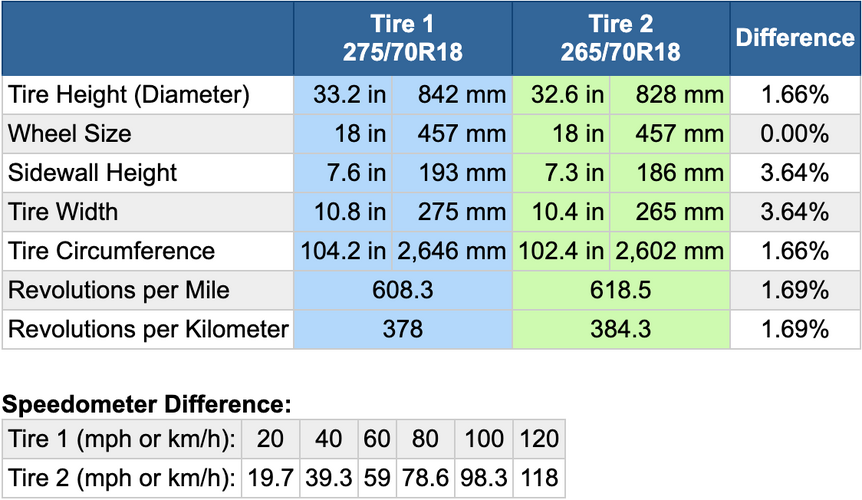
OK, on to my actual differences. it's only 1.66% so that does not account for 3MPG but does knock it down a little
Screenshot 2025-01-10 at 9.31.18 AM.png

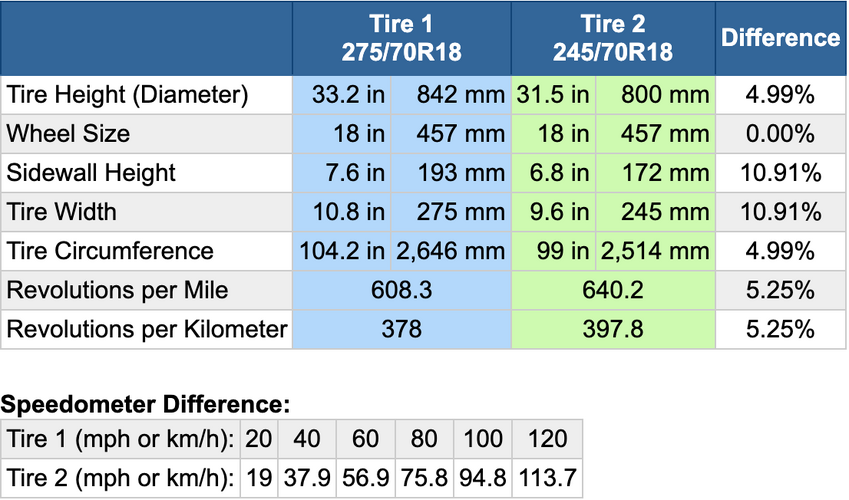
5% when compared to the little 245's on the 1958
Screenshot 2025-01-10 at 9.35.22 AM.png

At the end of the day this has been the most sensitive vehicle I've ever owned with respect to tires. Bumping my 80 up from OEM P-rated 31's to LT 33.5's didn't see this much drop. Now on 37's the truck still gets 13-14MPG where it got 16.5 generally stock with an occasional 18 on the HWY. All calculations here corrected for tire size.
 

DaveInDenver

Rising Sun Ham Guru
Joined
Jun 8, 2006
Messages
14,353
Location
Grand Junction
All manufacturers over estimate speed. In some places it's illegal to have your speedometer indicate under actual speed. So global OEMs deliver a vehicle that will always show you traveling faster than you actually are. With new cars they can tweak this in the ECU so it should be pretty uniform but it will very likely always be low.

In the U.S. there's no rules for passenger vehicles but the manufacturers developed a spec in SAE J1226, which states +/- 4% of the range. That means if the speedometer shows 120 MPH as maximum the error could be +/- 4.8 MPH, for example, and still meet J1226. There's nothing that requires it, though.

The U.S. does regulate commercial vehicles under the Federal Motor Carrier safety, which states +/- 8 km/hr (5 MPH) at 80 km/hr (50 MPH), thus +/- 10% generally.

However in Europe the rule is ECE Regulation 39, which says the speed must not be over but within 10% + 4 km/hr. This is similar in Australia I believe. So if you're going 60 km/hr the needle could indicate exactly 60 km/hr up to 60 *0.10 + 4 = 70 km/hr.

So to make everyone happy they're probably going to pick the most restrictive and give everyone that.

My Suzuki DRZ400 dirt bike was pretty much at the +10% in error (50 MPH indicated was actually almost 45 MPH), which is the most I've personally ever seen. But it's a global bike so I suppose it has to be legal everywhere with every possible combination of regulations, models and tires, inflation pressure and loads.
 
Last edited:

Rzeppa

Rising Sun Member
Joined
Aug 24, 2005
Messages
9,029
Location
Kittredge CO, USA
I'm still on the original tires that mine came from the factory, and I have observed (1) a ~3MPG drop in fuel economy from the first couple tanks to the most recent several tanks, from 24MPG to 21MPG, and (2) also note that my speedo reads 2-3 MPH more than what the radar trailers say. I do try to stay out of the turbo unless I need to accelerate rapidly to merge into traffic.

As far as the wheels, why not just get another set from Toyota? I'm seriously considering that. I have a second set of wheels/tires for my wife's Yaris and RAV4, with Blizzaks/Nokians for winter and all seasons for summer.
 

Rzeppa

Rising Sun Member
Joined
Aug 24, 2005
Messages
9,029
Location
Kittredge CO, USA
All manufacturers over estimate speed. In some places it's illegal to have your speedometer indicate under actual speed. So global OEMs deliver a vehicle that will always show you traveling faster than you actually are. With new cars they can tweak this in the ECU so it should be pretty uniform but it will very likely always be low.

I had this discussion with BVB at a meeting this past summer and he told me that the speedo software on new Toyotas is hard coded and can NOT be tweaked, not even if the ECU is reflashed.
 

DaveInDenver

Rising Sun Ham Guru
Joined
Jun 8, 2006
Messages
14,353
Location
Grand Junction
I had this discussion with BVB at a meeting this past summer and he told me that the speedo software on new Toyotas is hard coded and can NOT be tweaked, not even if the ECU is reflashed.
I believe that. It's got to be a security issue with regulatory bodies and the odometer accuracy. Although I suspect there's a way if you burn new firmware. Although maybe not, they could write this to secure flash. I have seen some cars can get their odometer corrected if you swap gauge clusters or main computers.

It's not really my point. I just meant that the OEM could customize the ECU values based on models and options. Some of them are very wide ideed. The Bronco comes with tiny 255/70R16 (approx 30"x10") base tires up to 37"x12.50" in the Raptor from the factory. They have got to have some way of correcting that. In the old days when Toyota only offered 28.5" base and the "big" tires were 31"x10.50" the little gears didn't have to changed by the dealer doing the up fit.
 

Corbet

Moderator
Staff member
Joined
Oct 24, 2006
Messages
10,571
Location
Durango, Colorado
As far as the wheels, why not just get another set from Toyota? I'm seriously considering that. I have a second set of wheels/tires for my wife's Yaris and RAV4, with Blizzaks/Nokians for winter and all seasons for summer.

Jeff, I want a little more offset to open up the trucks stance a little. Just not stick out past the tops of the wheel well or I'd definitely consider a 2nd set of OEM wheels. That is the most affordable option. There is a set in Denver on facebook marketplace for like $600. I could run spacers but no thanks. +40mm is the magic offset for my needs.
 

DaveInDenver

Rising Sun Ham Guru
Joined
Jun 8, 2006
Messages
14,353
Location
Grand Junction
You might find this interesting @Corbet. I keep a MPG log for our cars. Always have. I like to watch it over time and from fill up to fill up to watch for trends or signals. Over time you can start to see how a tune-up helps or when you need to address something like that.

Anyway, I have about 10 years of data on my Tacoma.

Total fill ups is 556 to date, 85,981 miles (~129k on the truck now). Of those 203 are summer and 353 are winter. I defined summer as 4 months of June to September inclusive, which should cover summer blend fuel with high probability.

My lifetime MPG average is 15.98 with a standard deviation of 2.05.

Of the 203 summer fills 119 (58.62%) came in above average and is 36.51% of the tanks
Of the 353 winter fills 148 (41.93%) came in above average and is 63.49% of the tanks

I haven't yet done any secondary analysis such as normalize for number of miles or do a summer-vs-winter MPG calculation. Anecdotal observation is that the number of 4WD trips is of course higher in summer (which you would think would reduce average MPG) but the number of long trips is pretty uniform. I'm just as likely to have done a 1,000 mile road trip with lots of Interstate in the winter visiting family for holidays as I would a summer recreational trip. I don't switch tires in the winter and use the same oil type and weight all year.

It would seem at first pass that the difference in gasoline blends may have a fairly significant impact. What cannot be easily explained would be that winter air is colder, thus more dense. But that should have helped power and maybe MPG, not hurt it. Maybe it's a balance, extra power is offset by increased air resistance on the truck. I dunno, this is just speculation.

In the chart the red line is the 10-period moving average. You can see significant changes. For example I lifted the truck and put on 235/85R16 skinny tires in October 2015, where the line visibly dipped. Changed again in November 2019 (to larger 265/75R16, so technically I need to correct miles by a few percent, these values are actual odometer readings). The WilderNest went on in winter 2018 (although I've always had a camper shell on) and the ARB bumper went on in summer 2016 (this I think really fouled the airflow).

lifeoftruck.png
 
Last edited:
Back
Top