Tire talk

MileHigh80Guy

Rising Sun Member
Joined
Nov 19, 2024
Messages
137
Location
Arvada
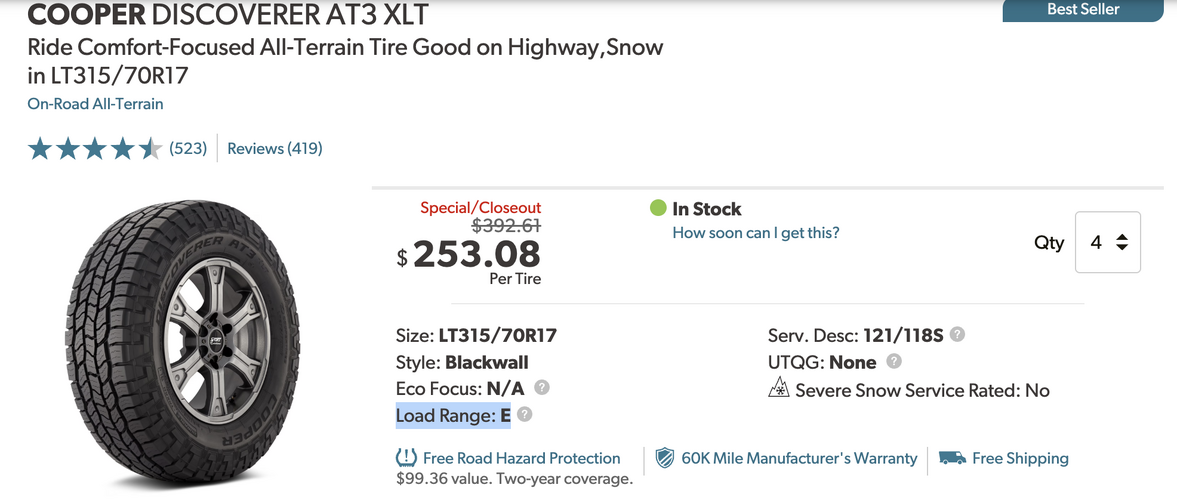
Little off current topic, but on generally on topic, the load range got me looking at my recent purchase to confirm....

Snagged 5 of these, loved them on my other vehicle, they are close out, so act fast.

Quiet, grippy, all around tire wears like iron.... Wanted to stay 16, went 17", but options are drying up faster than Lake Powell in a "35" for 16s.

@Johnny Utah approved.
Cooper Discoverer AT3 XLT LT315/70R17 Load Range: E (on topic)

$ 253.08

WITH ROAD HAZARD!
Screenshot 2026-09-08 at 6.57.29 PM.png
 

MileHigh80Guy

Rising Sun Member
Joined
Nov 19, 2024
Messages
137
Location
Arvada
Loving the Maxxis razr at on my daughters 3rd gen runner. Still early for full review as they’ve only been on 6k. But been great on the trails we’ve ran and a lot commuting and they look new.
Those Maxxis's seem awesome! Those, Nittos and the Milestars were on the 17" short list, but price and research paralyzation led me to the Coopers.
 

Oneops

Trail Ready
Joined
May 12, 2021
Messages
314
Went with tire easy.com cheapest I found
 

DomOfTheDead

Event Coordinator
Joined
Jun 2, 2019
Messages
1,320
Location
lakewood
Loving the Maxxis razr at on my daughters 3rd gen runner. Still early for full review as they’ve only been on 6k. But been great on the trails we’ve ran and a lot commuting and they look new.
I remember hearing commentary from Big Mike at Marlin, that he was happier with the Maxxis Razrs over the Cooper STT/Pros on his 3rd gen taco. Better trail performance and longer lasting compound
 

Wild-FJ

Rising Sun Member
Joined
Feb 3, 2026
Messages
49
Question on tire pressure: 2014 FJ Cruiser. Stock tire size is 265/70R17. On the door panel it says
PSI should be 32 lbs. When I increase the tire size to: 285/70R17 - what tire pressure should I set the tires for - for daily driving.
Thanks for any help.
 

DaveInDenver

Rising Sun Ham Guru
Joined
Jun 8, 2006
Messages
14,344
Location
Grand Junction
Question on tire pressure: 2014 FJ Cruiser. Stock tire size is 265/70R17. On the door panel it says
PSI should be 32 lbs. When I increase the tire size to: 285/70R17 - what tire pressure should I set the tires for - for daily driving.
Thanks for any help.
Are you using P-rated or LT-rated tires?

Starting with a P265/70R17 in SL load rating 113 at 32 psi would carry 2,425 lbs. When you mount a P-metric tire on a light truck you apply a 10% reduction so the actual allowable capacity for this tire on an FJC is 2,425 lbs / 1.10 = 2,205 lbs.

Sticking with a P-metric tire in 285/70R17 with an SL 117 load would carry 2,480 lbs (2,255 lbs corrected) at 26 psi.

Moving to a LT285/70R17 in either range C or E would require 38 psi to carry 2,231 lbs. Using an LT tire on a light truck is the correct application so no 10% adjustment is required.

My Tacoma came with P265/70R16, which at 32 psi carry 2,326 lbs (2,115 lbs) and the standard conversion to the LT265/75R16E that I run suggests 41 psi to carry 2,136 lbs. That's about what I run (I tell Discount to use 42 psi during rotations) and feel I get good wear and handling.
 

Wild-FJ

Rising Sun Member
Joined
Feb 3, 2026
Messages
49
Holy Batman - what a answer! Thank you.
Actual tires:
LT 285 / 70R17 - 121/118S E, Toyo Open Country, AT3
From your answer I should put 38 lbs. PSI ?
 

DaveInDenver

Rising Sun Ham Guru
Joined
Jun 8, 2006
Messages
14,344
Location
Grand Junction
Holy Batman - what a answer! Thank you.
Actual tires:
LT 285 / 70R17 - 121/118S E, Toyo Open Country, AT3
From your answer I should put 38 lbs. PSI ?
Use it as a starting point. Strictly speaking the manufacturers will tell you this should be your inflation floor, you know, 'cause safety and Explorers rolling over.

You should do a tread pattern test to make sure you're not too far off. That's where you rub chalk over the tread to make sure you're not putting uneven pressure down. People will use the placard as gospel and when moving to an LT this will be under inflated. Nevermind the load capacity aspect it will basically guarantee you cup the tires and wear the shoulders before the middle of the tread.

But yes, you'll find that 38 psi is probably about right, though. I tend to run a little higher because I'm chasing tire life and run on the high margin of GVWR.
 
Last edited:

allen.wrench

Rising Sun Member
Joined
Dec 7, 2018
Messages
865
Location
Syracuse, UT
For the fun of using the spreadsheet, I would estimate 27 psi is what might work for you @Wild-FJ

Based on uncle google, I did assume your FJ weighs 4343 lbf. The Toyo tires are supposedly rated to a max single tire load of 3197 lbf at max 80 psi. Answer obviously changes based on more specific values like if your FJ weighs a lot more.

Screenshot:
1789585750106.png

All the same, agreed with Dave's write up for a starting point. For tires I've never used before, I would lean towards higher pressures until I know how the tires behave. Too low of tire pressure is potentially more dangerous due to parts of the tire flexing too much, building up heat, delaminating, and then zipping open on the highway. Too high of tire pressure, as long as it's within the tire's capacity, is still not ideal but less dangerous and likely just wears poorly, feel like driving on bricks, and maybe better MPG.

Hope that makes sense. Clear as mud? :D

Allen
 

Attachments

  • 1789585461817.png
    1789585461817.png
    9.7 KB · Views: 30

DaveInDenver

Rising Sun Ham Guru
Joined
Jun 8, 2006
Messages
14,344
Location
Grand Junction
For the fun of using the spreadsheet, I would estimate 27 psi is what might work for you @Wild-FJ
Is this going to be under inflated? Toyota suggests 32 psi on a P-metric but one presumes they do this to achieve the axle rating under worst case conditions, at GVWR and cornering.

Is it a good idea to assume your worst case at 1/4 of total GVWR, for example? If it was simply a matter of 25% of the total then they'd have given something much lower than 32 psi in the first place, right? That 38 psi calculation is like-for-like replacement and 27 psi strikes me as more than a slight tweak in inflation. LT range C would be 50 psi max, range E is 80. But those don't change the adjustment, just the tire's max load. Both would be 38 psi suggested replacing a SL.

I'm throwing this stuff out because on a public facing forum you might want to be careful of engineering recommendations you give. Sidewall flex heating is not totally hypothetical.

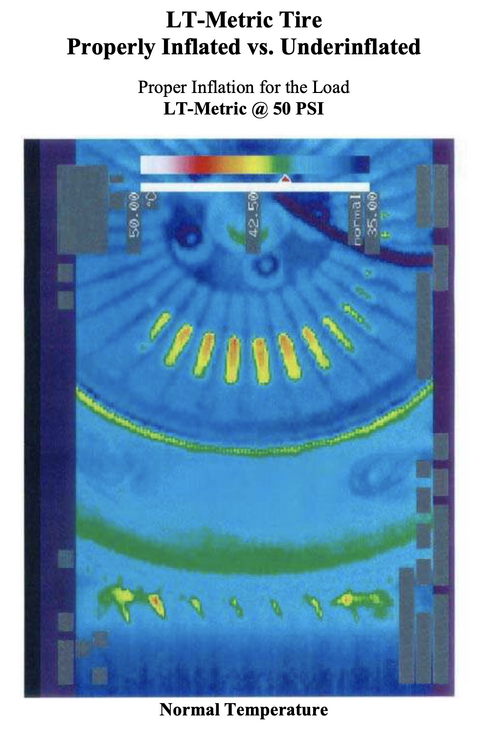
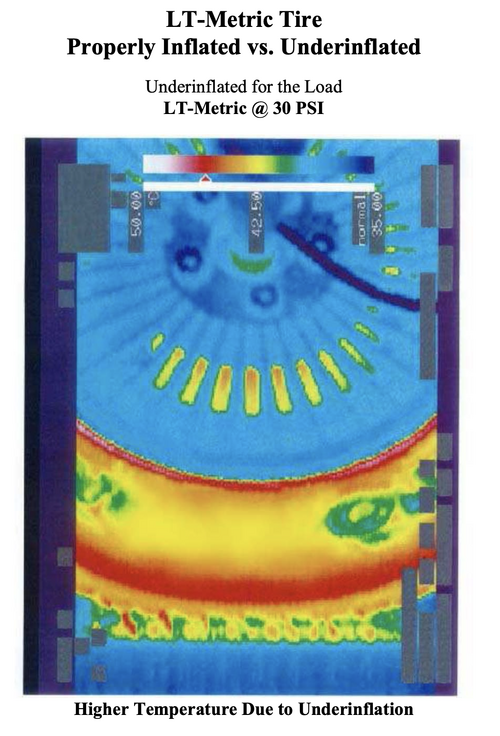
From the Nitto NTSD-12-011 tech note. They do cover themselves with "inflation for the load" which very well could be at full load, they only say it was equivalent (they don't say it was the same, though it's implied by saying proper and under inflated) for both.


Screenshot 2026-09-16 at 13.23.12.png

Screenshot 2026-09-16 at 13.22.14.png

Screenshot 2026-09-16 at 13.22.32.png
 
Last edited:

allen.wrench

Rising Sun Member
Joined
Dec 7, 2018
Messages
865
Location
Syracuse, UT
ok, fair point Dave.

27 psi calculated out for vehicle weight 4343 lbf as uncle google provided. If GVWR is used from google, 5570 lbf, then 35 psi comes out. Folks are welcome to use the publicly available math. It is available in many places not just this forum. I am only sharing what is publicly available. My estimations are not anything that must be done. Just for consideration and discussion.

Screenshot of the math using FJ GVWR:
1789587610567.png

To be even more clearer, I am not here providing engineering advice. I do understand there is a gray area. I have stated some primary assumptions, I only did it for fun (not professional advice, I am not being paid anything), and everyone takes responsibility for their choices. I have no authority to tell people what they choose to do. I am just some dude on the internet.

And like I said:

All the same, agreed with Dave's write up for a starting point. For tires I've never used before, I would lean towards higher pressures until I know how the tires behave. Too low of tire pressure is potentially more dangerous due to parts of the tire flexing too much, building up heat, delaminating, and then zipping open on the highway. Too high of tire pressure, as long as it's within the tire's capacity, is still not ideal but less dangerous and likely just wears poorly, feel like driving on bricks, and maybe better MPG.

Hope that makes sense. Clear as mud? :D

Allen
 
Back
Top