Portable Fridge Power

Romer

Moderator
Staff member
Joined
Aug 22, 2005
Messages
10,781
Location
Centennial, Colorado
Something I'd also like to know is if the Danfoss style fridges have as much loss on 120V. I have a feeling the compressors in them run on AC and might be natively higher voltage. So they may incur loss at 12VDC doing the step up and would have an inherent inverter loss internally. They may actually run on 120VAC better than an Engel. Not that 3W is horrible. If a Danfoss runs at 40W on DC I wonder if that stays even or maybe even goes down on 120V.
sorry, but I don't have the equipment toi monitor that

I put the 12 ah battery on the charger, they do lose charge over time and will test it with the National Luna starting later today. No need to wait for the new fridge. I will just run one compartment instead of the dual zones. I will post up when I start the test.
 

DaveInDenver

Rising Sun Ham Guru
Joined
Jun 8, 2006
Messages
14,327
Location
Grand Junction
sorry, but I don't have the equipment toi monitor that
Sure you do. It might be implicit in the run times. I'm not asking for ugly details, just people's observations if they're interested. It could be a +/- 10% difference, maybe a couple of hours and that's potentially measurable. Time over hours is probably more accurate than the resolution of the ADC in a Kill-A-Watt like I have, too. We're talking tens of watts, which is in the error noise for those power meters intended to measure 1500 watts full scale.

unnamed.png
 
Last edited:

Romer

Moderator
Staff member
Joined
Aug 22, 2005
Messages
10,781
Location
Centennial, Colorado
I tested the National Luna. I did two tests;
  • First from ambient to cold and how long it would last
  • Second, I plugged it in and got it to temperature and then swapped it to the Battery to see how long it would last
The second scenario is more applicable to what I am thinking. You get to a campsite after driving with the Fridge powered. You are going to be there several days and don't want to run down your battery. That is true for dual battery systems like I have as well

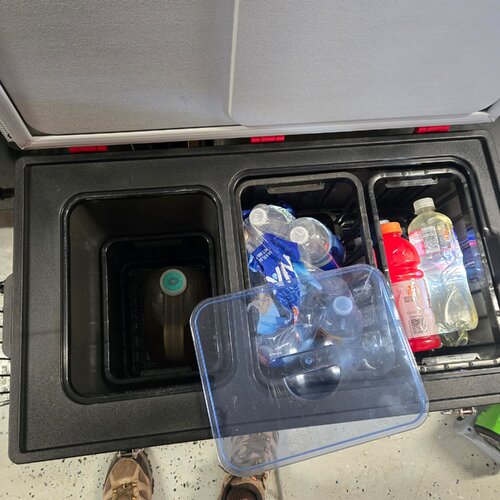
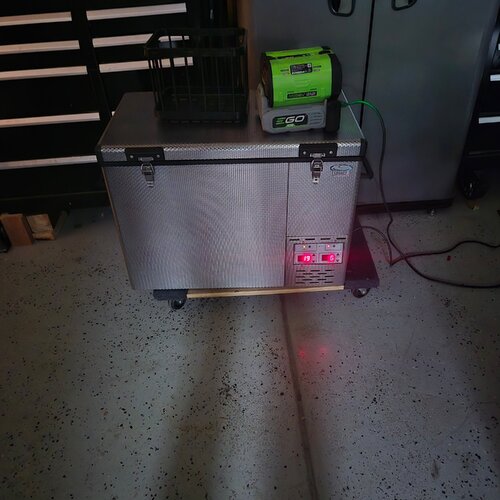
First I loaded the fridge with drinks to simulate a mostly full fridge
20260912_145826.jpg

My Garage was at 28C or 82 deg F

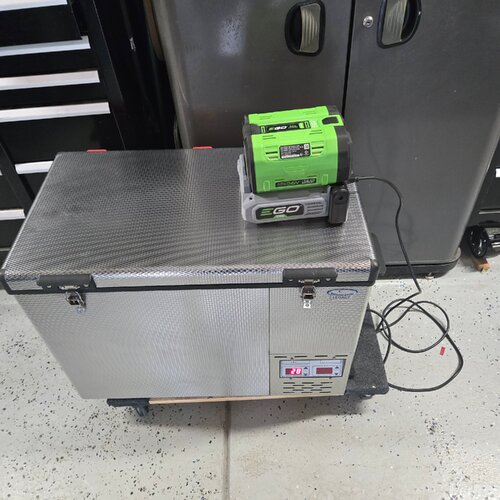
I then plugged the Ego 12 Ah battery into the Ego PAD5000 Inverter. I plugged the Fridge into the 110 V output
20260912_145728.jpg

As a disclaimer I am not looking for or trying to say this is a great or the best setup to use a battery to power a Fridge. I was curious what batteries I already had would do.

This test was with a single 56V 12Ah battery. I have two 12Ah and two 10 Ah and even a 7.5Ah and 5Ah battery. the 12's came with my 28" snowblower (which is awesome) and I bought the 10's on ebay as backups if the batteries run out before I finish my neighboors and my driveways (which are long). What this means is I can sawp out batteries to extend this if I want to.

These batteries are all 3 years old and have been charged/recharged many times

I did not open the fridge while running the test


Ok, Test scenario 1 with the Freezer side (left) set to 20 deg and the right side set to 6 deg C or 43 deg F. Note: either side can be a freezer. The battery lasted 15 hours. This is a guess +/- 1 hour based on the last time I saw it running and when it stopped which was a 2 hr window

Test scenario 2, with the fridge already at temp, the battery kept the fridge powered for 20.5 hours. I was right there when it shut off so no guessing.

This fridge is bigger than the one I just bought. It will be interesting to see if there is a difference when it gets here
20260913_181722.jpg

I like Ego products. I have the 28" snow blower, leaf blower, leaf vacuum, saw and a pole saw.
 

LARGEONE

Rising Sun Member
Joined
Jun 12, 2007
Messages
3,355
Location
Broomfield, CO
I have been running a similar setup as I got rid of my dual batteries in the 80. Similar in the sense I’m using a backup 50ah LiFePo. What I have found is that I get far less than theoretical when I’m grabbing lots of beers out on a hot day :). The fridge runs way more inside the hot truck and even more when it is being opened constantly. That said, my new ICECO does way better than the China fridge I had been running. That thing used more power and it ran nonstop due to poor insulation. (But it sure is light to get into and out of the truck!) :)

I use a small 8amp LiFePo charger that only charges when my truck is running. So, I basically run off the 50ah lithium all the time and charge while driving. This means I do run out if I camp in one spot for several days. In that case I have to plug my solar panels in.
 

DaveInDenver

Rising Sun Ham Guru
Joined
Jun 8, 2006
Messages
14,327
Location
Grand Junction
I have been running a similar setup as I got rid of my dual batteries in the 80. Similar in the sense I’m using a backup 50ah LiFePo. What I have found is that I get far less than theoretical when I’m grabbing lots of beers out on a hot day :). The fridge runs way more inside the hot truck and even more when it is being opened constantly. That said, my new ICECO does way better than the China fridge I had been running. That thing used more power and it ran nonstop due to poor insulation. (But it sure is light to get into and out of the truck!) :)
If there's one major knock I have with my Engel MT45 it's the thin walls w/o super fancy insulation and the poor lid seal. I put a soft cover on it and that helps but it's still thin compared to the photos of that National Luna of Ken's. But I know their goal was to maximize interior space and I appreciate that. For the exterior space it fits a lot of stuff.

The major upside to an Engel is the Sawafuji compressor. One moving part and super efficient. I use about 3/4 of an A-hr per hour consumption just maintaining and that goes up to pretty reliably about 1 A-hr per hour when opening and closing it. I can pretty much bank on that in any conditions.

I've assumed this is because it's an uber dumb fridge with a dial so it's not trying to chase an exact temperature target. I tend to set it at about 1.5 on the dial and that ends up about 40°F inside with about 80°F outside. If it's really hot out the inside temp does rise and when it's cold stuff starts to freeze inside, so 1.5 on the dial seems obviously a duty cycle target rather than a temp.

I've owned the thing 19 years and I might as well not have a dial, it's literally never moved since I figured out where to set it. It's right above the usually-never-turn-my-Coors-to-beersicles point.
I use a small 8amp LiFePo charger that only charges when my truck is running. So, I basically run off the 50ah lithium all the time and charge while driving. This means I do run out if I camp in one spot for several days. In that case I have to plug my solar panels in.
 
Last edited:

Romer

Moderator
Staff member
Joined
Aug 22, 2005
Messages
10,781
Location
Centennial, Colorado
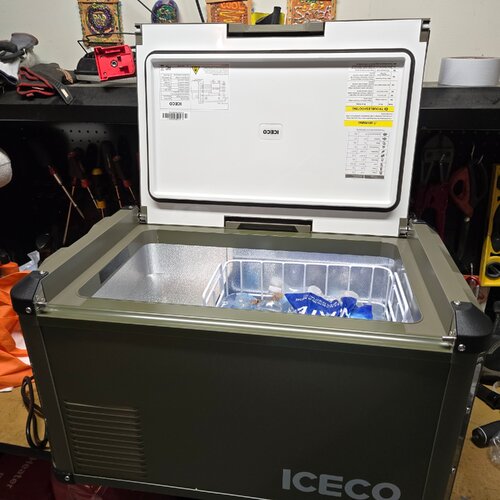
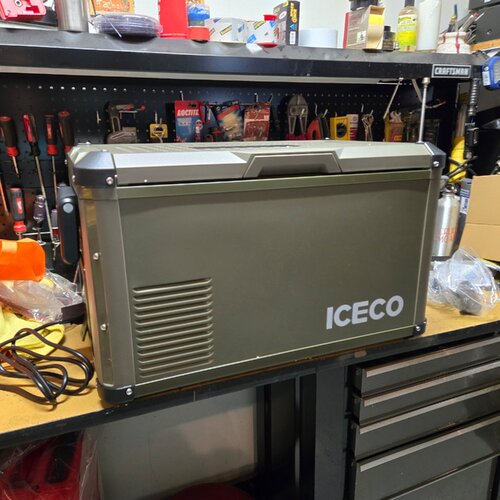
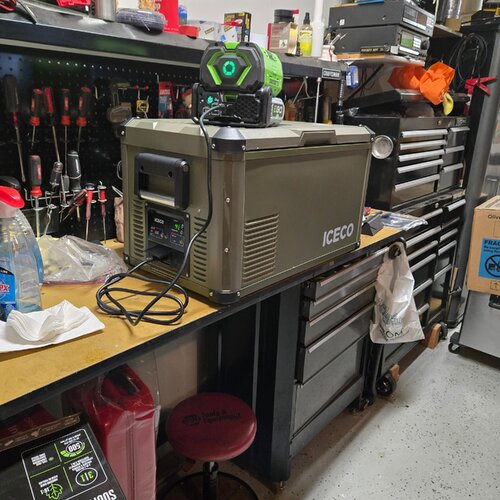
I got the new ICECO Fridge and ran the same test

83 deg F to 43 deg F was 15.5 hours

Maintaining at 43 deg was 25 hours

Both one the 56V 12Ah EGO Battery

Although the weather was a bit cooler during the maintain test

20260918_155230.jpg

20260918_155259.jpg

20260919_122625.jpg
 

DaveInDenver

Rising Sun Ham Guru
Joined
Jun 8, 2006
Messages
14,327
Location
Grand Junction
Great data Ken. Thanks for adding so much to the discussion.

Maybe there's something useful in all this, not sure yet just what though to do with it. Your results had me curious.

That EGO 12 A-hr is listed as 8 lbs. As you've said 672 W-hr. If we're going with 25 W-hr consumption (50W at 50% duty) you're taking 625 W-hr from it (25 W-hr/hr x 25 hr = 625 W-hr) and the inverter is 93% efficient. I think some of this is maybe leveraging quite a bit on the "wild" part of SWAG but it's ballpark close. I suspect the inverter is lower efficiency than that and the actual consumption is lower, so there's probably just a couple to a few hours penalty for convenience of using 120V.

Maybe say for round numbers you get 600 W-hr useful and then means 75 W-hr per lb.

My battery box, the plywood box, is 44 lbs. The box is of course quite a lot more volume and weight, there's handles and padding inside, so physically just more to it than the sleek commercial molded plastic and there's a fuse block, DC-DC & solar chargers inside so it's self contained.

Boiled down though, the closest like-for-like is the cells in it, which alone are 8.7 kg (4 x LEV60F at 2.17 kg each) so about 20 lbs. For this 20 lbs I get 962 W-hr (74 A-hr x 13V) by specification, so 48 W-hr per lb. My testing shows I reliably get 780 W-hr, which then is 39 W-hr per lb.

In my case that's ~60 A-hr consumed and is the point my cells begin to go wildly out of balance. They track at within about 5 to 8 mV from 100% through the discharge. I stop when the spread hits 25 mV, which is around 20% SOC. So I'm leaving around 14 A-hr on the table in the interest of lifespan on the cells.

Maybe this is a distinction of useful information. I selected these cells for a couple of reasons. One is they are LiFePO4 prismatic cells while EGO is using lithium-ion cells, which in the 12 A-hr pack is 56 ganged 18650 cylinder cells. EGO builds banks of 14 series cells to get 56V and I stole this image from a Reddit post to show how they assemble the packs to parallel them for larger capacity packs. In the case of the 12 A-hr it's Nickel Manganese Cobalt Oxide (NMC) in the Sony VTC6 type.

ego-power-56v-arc-lithium-batteries-breakdown-v0-9uy14gwolgvb1.png

My reasoning was primarily temperature concerns and general safety but for this I did knowingly accept lower energy density, e.g. watts per weight. We all have lithium cells all over the place, phones, powerbanks, laptops so the question of handling should always be at least in the back of the mind. But in this case it's kind of interesting to see a real life comparison of what LFP vs NMC. Lithium-ion to me is a bigger concern with unknown brands and quality cells or using poor BMS protection, neither of which is really a serious concern about a premium brand such as EGO.

Using LFP without a BMS or abuse can still be dangerous but they are generally better in an accident where they might be physically compromised, for example. Still, LFP is inherently safer by it's nature but for using it is that I have to carry around almost twice as much weight to get the same run time, which turns out to be a significant penalty for that choice. Truth told, until just now I never did the analysis to find out how much it actually was..
 
Last edited:

Romer

Moderator
Staff member
Joined
Aug 22, 2005
Messages
10,781
Location
Centennial, Colorado
Great data Ken. Thanks for adding so much to the discussion.

Maybe there's something useful in all this, not sure yet just what though to do with it. Your results had me curious.
Dave, there is something useful in it for me. Stuff I already own can be used to power the fridge for several days (Multiple Batteries) should I need to. Meaning there is no need for me to buy Icecos battery, a Jackery or other battery solutions out there.

This would come in handy if I went to a camping spot for several days and didn't want to run the truck to recharge my Dual battery system. This is a good augmentation to my Dual Battery system.

I can also use the battery setup for other things as well limited to 400 Watts at 110V

I wanted to see what stuff already in Romer's garage could do and I am pleased with the results. So pretty useful to me since I have a lot of Ego tools and batteries
 

DaveInDenver

Rising Sun Ham Guru
Joined
Jun 8, 2006
Messages
14,327
Location
Grand Junction
Dave, there is something useful in it for me.
I just meant to the community beyond you and me nerding out.

Suppose there are a few generalities that we're showing.

Like chemistry choice for lithium has a non-trivial impact in size, weight, capacity. Most people I think know this going from lead-acid to lithium and we knew this professionally. It's maybe interesting to a few people seeing the steps from theory to paper to real application comparing lithium-ion cells to lithium iron phosphate.

I think most Rising Sun'ers run their fridges directly on DC but seeing how putting an inverter in the chain consumes energy would be eye-opening to the #OLAF #Expedition #Vanlifers who more commonly are relying on a vehicle-wide 120V system with large batteries on the order of 400 A-hr and inverters in the 1KW to 2KW range.

On our scale it's a couple of hours, so I might go from 40ish hours to 36ish. You're gettting 25 hours where you might get 27 if you dicked around with a high efficiency DC-DC. It's an academic thing, not really going to change how often we'd have to run the engine to charge or deploy solar panels.

But those people figure on staying put for a week or 10 days. For them the efficiency of an inverter or using loads at native voltages could mean a difference of a day or more. It could mean needing 8 panels instead of 6 to meet their needs. This could pose a problem just finding roof space. They could run into real world challenges.

Actually, it's true of household scale systems like your solar. In off-grid things like cabins they'll sometimes use lights or appliances that run at the battery bank voltage rather than off an inverter because 10%, 20%, whatever the conversion efficiency can make a difference. Every watt-hour at the 10th Mountain Division huts for example, where getting more panels and replacing battery banks requires $$$$ helicopter loads during their summer maintenance windows.
 
Last edited:

DaveInDenver

Rising Sun Ham Guru
Joined
Jun 8, 2006
Messages
14,327
Location
Grand Junction
Doing some testing, this time to get some idea on whether running on 12 VDC or 120 VAC matters and if so how much.

120 VAC power measured using a homebrew watt meter, it's a Drok D85-2058 in a 3D printed box with a GFCI outlet. Seems accurate enough. The resolution is 0.01 kWhr (10 Whr) so not really lab quality, especially only using one day per run. But it's good enough for a first pass I think, so figure a +/- 10% SWAG.

12 VDC power measured using the Amazon special 200A (not actually safe for 200 A) watt meter. It's very convenient. I've checked it against known good voltage and current meters and it's good enough. This resolves to 0.01 Whr but I doubt accuracy is better than 2%, probably more like 5%.

I used a 12V power supply to run them on DC just because I was curious about it's efficiency and power factor, not really important to the actual energy consumption. The datasheet efficiency for this Meanwell LRS-150-12 is 87.5% and I found at these loads it's slightly lower than this. I might mention to anyone looking closely that this switched mode power supply is running about 0.6 power factor. Just a for what it's worth and I do not yet know if the Drok correctly shows watts or if it's actually volt-amps. It's showing ~120V so it's right on the voltage RMS so it might be right on watts.
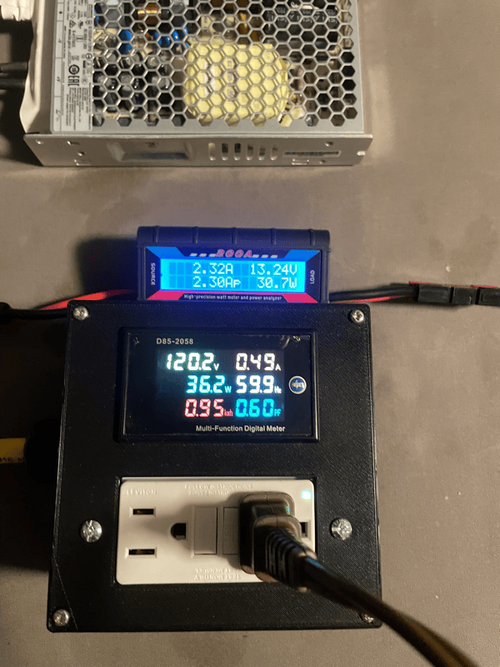
IMG_5584_mid.png

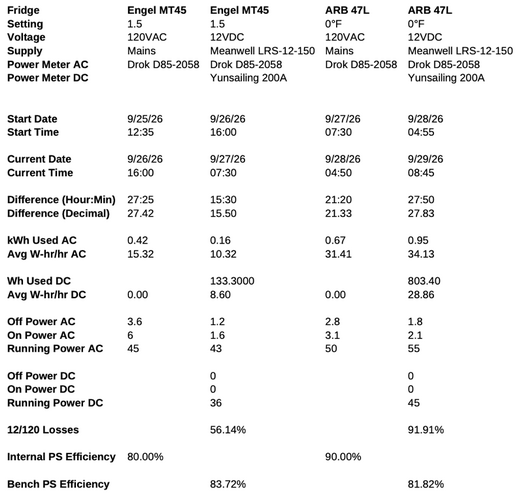
The results.

power_used_calc_mid.png

Don't read too much into the very large difference in energy used. The Engel is set to beer temp (about 1.5 on the dial, so ~40°F) while the ARB I have full of frozen food (set to 0°F). So using more energy isn't surprising. That it's quite this much is curious. I've not seen in practice that either of them is this much better or worse so I may do more looking into this once we eat the frozen food in the ARB and I can load them the same. Might really just be a duty cycle at temp difference since both have similar running power demand.

What is interesting is the apparent internal power supply efficiencies, how much is lost converting from 120 VAC to 12 VDC.

Both fridge compressors run on low voltage AC (about 27 to 45 VAC) so they both take the input voltage and modify it. The 12 VDC is run into a DC-DC boost and the 120 VAC in both is run through a small converter to make DC that is then run into the same boost as the battery voltage. I haven't tried to access the guts of the fridges so I don't know their internal efficiencies.

I can only imply the first stage AC to DC converter efficiency by looking at how much change there is between them.

Conclusion I'm drawing is running an Engel/Sawafuji on DC is very important. Seems to use almost 1/2 the power. While the ARB it's not as important, 120V seems to be only about a 10% penalty.

The calculation I used is (DC avg Whr/hr) / (AC avg Whr/hr)

Also need to mention that the Engel settles quickly to a running power on both 12V and 120V while the ARB jumps around between 40W and 55W on 120V so I used 50W as an observed approximation and not a mathematical average. It seems more stable on 12V. So I'm thinking the AC-DC converter they're using is more complex chasing efficiency, perhaps a resonant converter or something fancy. I need to go back on my notes and see if I notice a different in ripple or noise that would indicate anything. Use a battery on 12V might settle things, too.

The internal PS efficiency is (running DC power on 12V side) / (running AC power on 120V side)

The bench PS efficiency is (running DC power on 12V side) / (running AC power on 12V side)

BTW, don't use the ARB numbers as gospel on all Danfoss/Secop. The compressor and controller could be the same but the 120V to 12V internal voltage converter is designed by the fridge manufacturer and likely will vary, as might the 12V side temperature controller itself and the construction of the box/insulation/lid, too. The Danfoss/Secop parts can only do what they're told to do.

 
Last edited:
Back
Top