• REGISTER FOR RISING SUN'S 2ND BEST EVENT: THE COLOYOTA EXPO. IT'S ONLY $5, DUDE.
    → No extra fee to bring yer extra stuff and sell it at the swap meet.
    → It's not Cruise Moab, but it's way cheaper and you can sleep in your own bed.
    Businesses: Still time to register your company to be an exhibitor at the event, too!
    Click here to register today..

Utilities are trying to delay easy-to-use solar panels

GTBradley

Rising Sun Member
Joined
Feb 18, 2025
Messages
84
I'm a big proponent of making our own power, but utilities get in our way. I really don't understand Xcel asking us on the hot days to reduce power usage - or they will cutoff the power - and also asking state regulators to limit residential rooftop solar. In this NPR article it's reported that they want the new easy-to-use solar panels to be delayed.
Easy-to-use solar panels are coming, but utilities are trying to delay them
 

DaveInDenver

Rising Sun Ham Guru
Joined
Jun 8, 2006
Messages
14,247
Location
Grand Junction
Just actually did some continuing education hours on distributed energy, of which the plug-in solar is a subset.

Far be it from me to defend Xcel. Pretty ticked at them right now. They ARE greedy.

That said there are real concerns North American utilities bring up. One is islanding, which is where energy is backfed to the grid when the linemen expect it to be dead. Normal solar, like any grid-tied backup be it a generator or otherwise, has the service entry transfer switch to prevent this.

These things plug into an outlet and unless you flip open a breaker upstream the power is put back down the line. This is dangerous, not to mention you might try to power your neighbors in a black out. That should cause an over-current on a balcony solar and the UL certification will help with the anti-islanding through a bidirectional GFCI.

Their worry is what if someone buys some POS from Amazon that isn't really UL 1741 compliant to prevent this?

The other concern is touch proof plugs. In Europe they use the round Schuko outlets that are recessed so the prongs are not easy to expose. We use the NEMA type plugs that aren't touch safe when the plug is energized. Their design intention was the blades get de-energized if the cord is pulled even slightly from the outlet.

Also, what about when it's not plugged in? Can the plug prongs become hot if the panel is exposed to sun? This is the same situation where people make a double male plug extension cable for their generators. This is disallowed in the NEC, specifically Article 406.7(b) and 406.7(d), because it's easy to shock someone doing that.

The UL standard tries to address this as well with the GFCI requirement. You'll still feel the tickle if you touch the prongs but it shouldn't be fatal.

So one of the things the NFPA and UL are pushing for is requiring a touch-safe outlet panel you plug into in your house instead of a NEMA plugs.

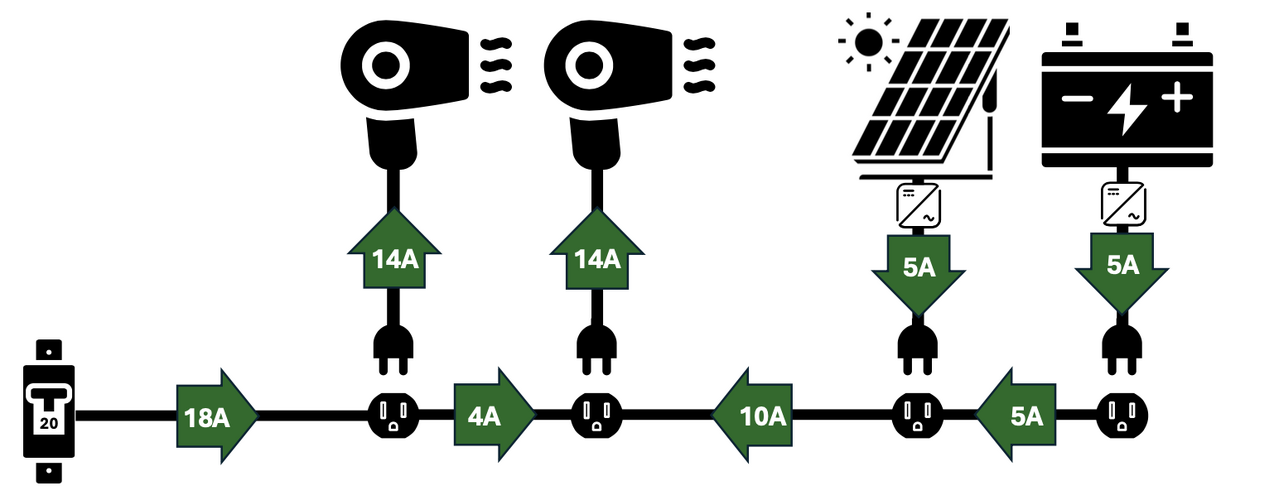
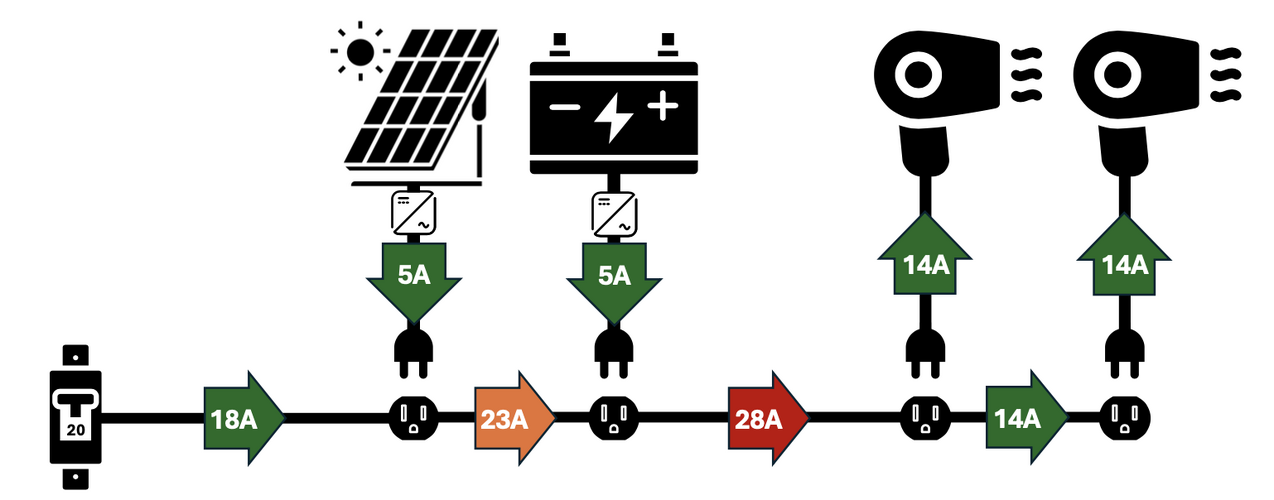
Another issue the codes are concerned with is breaker masking. This is where you put both a source and load on the circuit that bypasses the panel breaker. The way our wiring is done is the power path is grid -> meter -> main breaker -> panel breaker -> wiring -> outlet -> load. If you plug a source into a wall outlet and then run a load on that same circuit the panel breaker is not in the circuit. It only is if you run a load on a different circuit, in which case you actually have two breakers in the circuit.

This problem is present when it's operating normally. If you put the source upstream of the load then you could have both the panel power and generator source supplying downstream loads. There really isn't a good way to prevent this and whether it's safe is going to depend on the layout of the circuit.

It's shown in these graphics, the 14A loads being hairdryer as an example.

This first one is safe.
Screenshot 2026-03-12 at 16.21.56.png

This second one could cause a fire in someone's wall.
Screenshot 2026-03-12 at 16.22.13.png


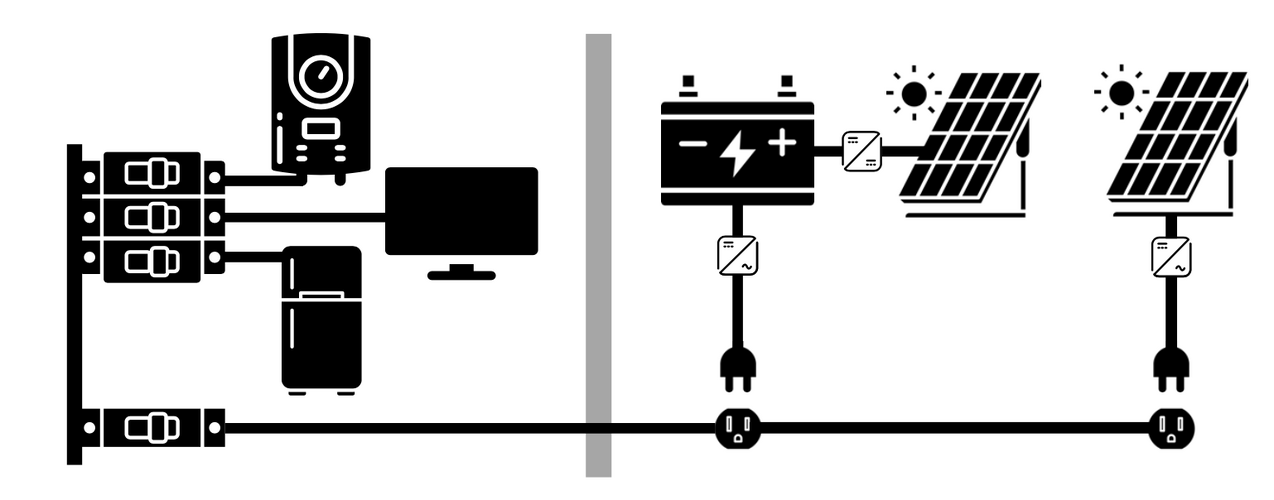
I think what you're going to see is the NEC address this by having a dedicated branch circuit for a portable solar/inverter/generator. It might require a special plug (addressing touch safety) and being dedicated it'll have a breaker in the panel to prevent masking.

Screenshot 2026-03-12 at 16.26.45.png
 
Last edited:

GTBradley

Rising Sun Member
Joined
Feb 18, 2025
Messages
84
I get it, but my thought on the legitimate concerns for the utility is for safety of the lineman. But, they already have that concern as people do all kinds of modifications to their house wiring, including hooking up generators without tripping the master to keep from powering the line to the pole. So, undoubtedly they already check for this and mitigate the threat before performing work. The rest of it is certainly valid, but it is on the homeowner to keep within code/safety procedures. The manufacturer of the device needs to be the one that regulators deal with and not have the utility start self-regulating things that get plugged in to the home wiring.

What frustrates me most is the utility making home solar upto twice as expensive to install when it should be about complying with electrical codes and permitting only. Especially when we need additional, clean energy production anyway.
 

DaveInDenver

Rising Sun Ham Guru
Joined
Jun 8, 2006
Messages
14,247
Location
Grand Junction
My main red flag is the breaker masking. Very few people recognize this issue. They see a 5A breaker on the inverter and think it's OK but that is not the case at all.

Even if you're aware of it conceptually you need to know with absolute certainty the topology and layout of your branch circuits to know which outlets you should use for the solar sources and which you should use for loads.

Maybe the best way of doing this is have a single device circuit, just one GFCI outlet, hung on your panel board with a 15A breaker and only use that for the solar. This is not specific advice, consult a cognizant engineer or electrician.

I'm only bringing the topics to discussion because I'm a licensed professional engineer and it falls on me and my peers (mostly peers, I only design to NEC, not write them) to use the code and figure out how best not to kill anyone or burn down houses. PEs literally put our money and legal reputation on the table when we stamp a design.

The lesser issue is shocking linemen and touch safe plugs, since GFCI does protect against this. The primary concern here is getting people to buy legitimate products and if there's one thing you see is pure junk coming from Amazon that I simply do not trust.

Here again, I'm not defending the utilities. They are using legitimate issues as way to resist progress and keep their monopolies. It's important not to let their political and business nonsense obscure the real issues, though.
 
Last edited:

GTBradley

Rising Sun Member
Joined
Feb 18, 2025
Messages
84
Yeah, whatever happened to the certifications? An, UL stamp on electrical products, when I was a kid, was so ubiquitous that I thought anything that used electricity was mandated by the government to be certified. It’s hard to find that now. If you get anything from Amazon with a cert it’s usually European, which is at least something. Most of the time consumers have no idea the things they buy from China are dangerous unless there’s an angry upheaval in the reviews.
 

DaveInDenver

Rising Sun Ham Guru
Joined
Jun 8, 2006
Messages
14,247
Location
Grand Junction
When you say certifications @GTBradley what do you mean? For electrical products? It's a very broad topic.

Generally when talking about electrical such as utilty-related, wiring, etc. it's the NFPA (National Fire Protection Association) who writes the NEC (National Electrical Code). This document alone isn't binding, just recommendations. But almost every municipality in the United States adopts it into their building code and this is what makes it legally binding. This is then enforced by requiring permits and inspections.

Beyond this the utility will have an engineering standards handbook that has their specific requirements. As a home owner you probably will never run into it but electricians and engineers often will. It'll define just about everything they expect to tie into the grid so that you don't screw up the coordination and stability. Xcel's is 206 pages and was last updated in Feb of 2026. It's the ground rules for using their power.


There's a similar set of rules published by the ICC (International Code Council) known as the IBC (International Building Code), which extends to the IRC (International Residential Code), IFC (Fire), IPC (Plumbing), IMC (Mechanical), etc (there are many of them). These are the various codes for the rest of the stuff. These are also adopted by building and zoning departments to make them legal documents.

Municipalities will adopt them as written, some adopt with amendments. A common one in Colorado is to adopt the building code with increased requirements for snow and wind loads. California adopts a lot of seismic amendments. Coastal places for hurricane. You get the drift, unique requirements that the basic code can't really anticipate.

Other bodies such as UL, IEEE, NEMA, CSA (in Canada), IEC (Europe) write standards or offer certifications for other things. Here again they are only documents full of recommendations that are voluntarily followed unless they get adopted by some government agency or municipality into a law or regulation. Sometimes it's an agency such as the Consumer Product Safety Commission or OSHA that adopts the standard as law. In other cases one code will reference the other. This is the case in the NEC where it occasionally calls for or suggests the use of NEMA devices. So by adopting the NEC the UL/NEMA certification is potentially a requirement by citation.

In cases where it's not a law a standard might be suggested contractually, such as your mortgage note holder or insurance wanting to see certifications. It might be important to ask because in some cases you could not know this until you make a claim. Say in the case of a fire the investigation determines you were not following NEC or UL and denies the claim. It may also come up during a sale or in the process of other work where a contractor or inspector notices.

Another way standards are enforced is by an employer or manufacturer doing so voluntarily, although this usually really stems back to an insurance or legal liability cover more than just because they care. Standards are the generally recognized best practices so you either follow them or document why you felt it necessary to deviate to CYA.

Does that word puke make sense?
 
Last edited:

GTBradley

Rising Sun Member
Joined
Feb 18, 2025
Messages
84
It does, but sorry I just meant consumer products. It just seems that they were all certified in years past and anymore the Chinese products have no certifications at all.
 

DaveInDenver

Rising Sun Ham Guru
Joined
Jun 8, 2006
Messages
14,247
Location
Grand Junction
It does, but sorry I just meant consumer products. It just seems that they were all certified in years past and anymore the Chinese products have no certifications at all.
In most cases the Consumer Product Safety Commission enforces standards in the U.S. There isn't a single umbrella law that says everything must be tested. There's several enabling laws the CPSC enforces.


If there's no federal law then it falls to states. California is the most obvious, you know the Prop 65 label they put on everything. "WARNING: This product contains chemicals known to the State of California to cause cancer, birth anomalies, or other reproductive harm."

Specifically on electrical products, there are provisions in the NEC that state UL device should be used but it's got a caveat that says "if available." It's more of a recommendation than a legal requirement even when it's adopted by a jurisdiction.

If a product doesn't fall under those laws then it's voluntary based on market and consumer demand. Simply put, if a manufacturer isn't being asked to certify then they won't. They determine this by what sells and what doesn't.

There's additional liability reasons. If a product is tested and is used like intended then the manufacturer can usually avoid being held responsible for injury or death. But this assumes the reputation is important to the manufacturer. When something happens to that crappy Amazon thing who's going to stand behind it? Amazon? Not a chance. The manufacturer? It's a backroom business in Guangdong province that probably doesn't even exist legally.
 
Last edited:
Back
Top