What the what?

Stuckinthe80s

Rising Sun Member
Joined
Dec 29, 2017
Messages
2,383
Location
Lakewood, CO
Sooo, on the way back from Moab I got all the way to the Genessee area when I started hearing a grinding noise coming from my back brakes. The sound was pretty awful so I parked the truck and haven't driven it since. Well, last night I finally got around to looking at it and guess what I found on my passenger side:


caliper.jpg
brake caliper.jpg
wheel.jpg
 

Stuckinthe80s

Rising Sun Member
Joined
Dec 29, 2017
Messages
2,383
Location
Lakewood, CO
The top caliper bolt had backed out and the caliper itself was being pushed against the wheel when braking. I can't tell you how many sets of brakes I've worked on and this is the first time this has happened to me. I put new pads, rotors and calipers on right before Cruise Moab and I would have bet money that everything was super tight before I left. Admittedly, I didn't put a torque wrench on it but my calibrated wrist hasn't let me down before.

The possibility of this sort of thing happening always makes me a little paranoid and I always double check my fasteners after completing a job like this. I'll admit that I was in a bit of a hurry trying to get everything finished before Cruise Moab but I was trying to be thorough during the entire process to make sure this kind of thing didn't happen.

So the moral of the story is, check your nuts! Well, in this case, your bolts too!
 

DaveInDenver

Rising Sun Ham Guru
Joined
Jun 8, 2006
Messages
14,249
Location
Grand Junction
So you didn't use red Loctite on the caliper bolts then, right?

Some bolts I'm OCD about using the torque wrench but in this case I'd do at least a couple of uggas with a medium length breaker bar if I didn't have one.
 

Stuckinthe80s

Rising Sun Member
Joined
Dec 29, 2017
Messages
2,383
Location
Lakewood, CO
So you didn't use red Loctite on the caliper bolts then, right?

Some bolts I'm OCD about using the torque wrench but in this case I'd do at least a couple of uggas with a medium length breaker bar if I didn't have one.
Right, no red loctite. I've got mixed emotions on using loctite on these bolts. I'm not going to argue that it's not a good idea, I've just never needed it before.

And my typical practice on these bolts is exactly like you described: run them down with a ratchet and then get them tight with a 3/4" drive breaker bar.
 

DaveInDenver

Rising Sun Ham Guru
Joined
Jun 8, 2006
Messages
14,249
Location
Grand Junction
I don't know if it's a good or bad idea. The FSM for my truck does not say to use it and IIRC new bolts from Toyota don't come with it pre-applied as some of their fasteners do.

Now that you mention it though I might only use blue on caliper bolts because stripping a spindle is bad, too. Some places, like the two bolts on my truck that hold the lower ball joint assembly always get red, though.

My reasoning is the caliper goes through a lot of heat cycles and my gut tells me the bolts need it. So pretty unscientific I suppose.
 

nuclearlemon

Hard Core 4+
Joined
Aug 23, 2005
Messages
8,702
Location
windy wyo
on an 80 , you need red loctite. ask me how i know ;)
 

Corbet

Moderator
Staff member
Joined
Oct 24, 2006
Messages
10,137
Location
Durango, Colorado
Those are bolts I'm pretty religious about using the torque wrench on. And unlike nearly every other chassis bolt I re-install I do not but anti seize on them or loctite though blue sounds like a good idea if anyone were to have any doubts. Don't think I'd go red personally.

Happy to see you only had a little rub verse a total failure.
 

Stuckinthe80s

Rising Sun Member
Joined
Dec 29, 2017
Messages
2,383
Location
Lakewood, CO
A 3/4 breaker bar sounds excessive.

Are you positive you tightened it? Maybe you were busy thinking about getting ready and forgot. It happens.

Well, I don't put all of my weight into it. I just use it for the extra leverage seeing as how there's not a ton of room/throw in that spot. And yeah, the last two weeks building up to Moab was a blur. I can't guarantee that I tightened it but I can moving forward. I've made a lot of mistakes in my life but I typically don't make the same ones twice. This incident will always be on my mind every time I do brakes from this point on.

on an 80 , you need red loctite. ask me how i know ;)

Ige, Fat Bastard needs red loctite on every fastener he has with your driving. :p:

Those are bolts I'm pretty religious about using the torque wrench on. And unlike nearly every other chassis bolt I re-install I do not but anti seize on them or loctite though blue sounds like a good idea if anyone were to have any doubts. Don't think I'd go red personally.

Happy to see you only had a little rub verse a total failure.

Thanks for the kind words. The Cruiser gods were definitely looking out for us on this one!
 

ccslider

Hard Core 4+
Joined
Apr 20, 2015
Messages
1,172
Location
Westminster
I had a front wheel loosen up. It's been torque wrench checks pre a and post trips after that!

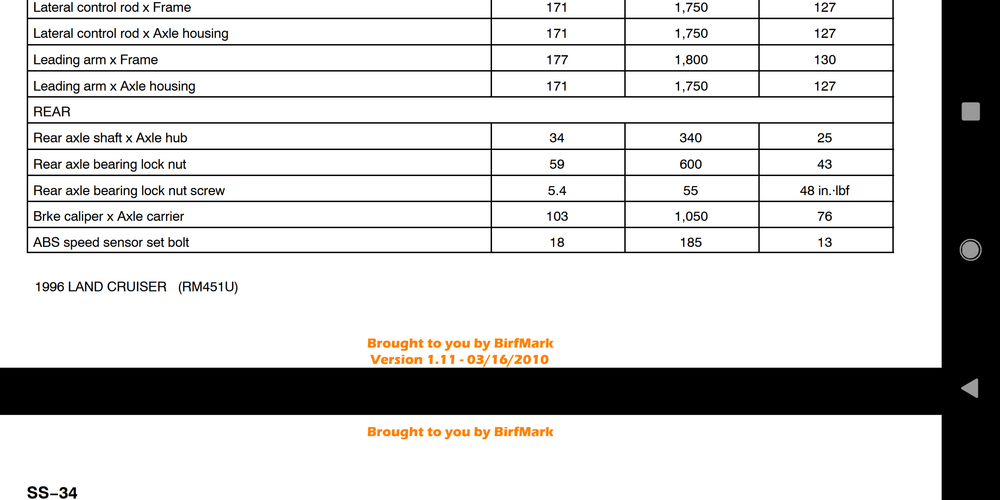
BTW the caliper bolts for rear show 76ft lbs. That's more then I expected
 

Stuckinthe80s

Rising Sun Member
Joined
Dec 29, 2017
Messages
2,383
Location
Lakewood, CO
I had a front wheel loosen up. It's been torque wrench checks pre a and post trips after that!

BTW the caliper bolts for rear show 76ft lbs. That's more then I expected
Damn! That is a lot! That's more than the torque spec for head bolts on a small block chevy!
 

rover67

Rising Sun Member
Joined
Nov 1, 2007
Messages
9,733
Location
Boulder, Co
I've become a geek about torquing fasteners. Typically I find I either grossly overtorque (valve covers, hub flange studs, oil filters, fill and drain plugs, intakes, etc.) or grossly undertorque (calipers, suspension, u bolts, etc.) The bad thing is on some components, and I think back to my stripped caliper bolt, sometimes the torque value is really high and guessing can lead to fasteners that yield, or stripped mating threads. Consistent overtorquing can also lead to failed mating threads in softer materials like cast iron. As an example I was watching George's video on t case rebuilds a few days ago and he zips things down with an air wrench or by hand everywhere. While with experience that can be just fine, and a lot of full time very experienced mechanics do it this way I just don't have the right touch I've found. Even with years of building things. When I worked in a transmission shop years ago the guy I worked with would do everything with an air impact. even the 10mm Head, 6mm thread bolts that hold valve bodies one... I don't ever think I could do that correctly. Also, a lot of times our stuff comes apart too often to risk stressing the threads.

On whether to use loctite or not, I have not used it much on caliper bolts. I like to go by factory recommendations. Same as I liek to do with gaskets... If they call for an added sealer I use it. if not it goes on dry. I've found that on everything except for british stuff and specific parts people have a lot of data on doing it this way has yielded good results. With British stuff if you don't use Hylomar, tons of silicone, or something else you are going to have leaks. And you'll appreciate the Hylomar when it comes apart the 1,000th time. You'll also strip all the coarse SAE threads if you tighten them enough or they'll come loose. That is kind of a joke but true. With stuff like Porsches there are all kinds of specific things I learned when I went to Porsche engine building school you are supposed to do that deviates from factory. it is well documented and based on years of data from previous builds. With Toyota, so far, for the most part, like factory recommends has been fine. Now do Iuse loctite on stuff I am worried about? Yeah probably. As long as I want it to come apart.. then I use blue. I'll use red if its a fastener that I can't get perfectly clean. If you use red on a perfectly clean fastener and they don't get heated (like a caliper bolt maybe) they usually don't come out very easily. I think that's why most people who use red get away with it.. it goes on bolts that get hot or aren't clean.

Now I'll eat my words when the caliper bolts I torqued to spec with no loctite on the 80 come loose lol.

 

Stuckinthe80s

Rising Sun Member
Joined
Dec 29, 2017
Messages
2,383
Location
Lakewood, CO
I've become a geek about torquing fasteners. Typically I find I either grossly overtorque (valve covers, hub flange studs, oil filters, fill and drain plugs, intakes, etc.) or grossly undertorque (calipers, suspension, u bolts, etc.) The bad thing is on some components, and I think back to my stripped caliper bolt, sometimes the torque value is really high and guessing can lead to fasteners that yield, or stripped mating threads. Consistent overtorquing can also lead to failed mating threads in softer materials like cast iron. As an example I was watching George's video on t case rebuilds a few days ago and he zips things down with an air wrench or by hand everywhere. While with experience that can be just fine, and a lot of full time very experienced mechanics do it this way I just don't have the right touch I've found. Even with years of building things. When I worked in a transmission shop years ago the guy I worked with would do everything with an air impact. even the 10mm Head, 6mm thread bolts that hold valve bodies one... I don't ever think I could do that correctly. Also, a lot of times our stuff comes apart too often to risk stressing the threads.

On whether to use loctite or not, I have not used it much on caliper bolts. I like to go by factory recommendations. Same as I liek to do with gaskets... If they call for an added sealer I use it. if not it goes on dry. I've found that on everything except for british stuff and specific parts people have a lot of data on doing it this way has yielded good results. With British stuff if you don't use Hylomar, tons of silicone, or something else you are going to have leaks. And you'll appreciate the Hylomar when it comes apart the 1,000th time. You'll also strip all the coarse SAE threads if you tighten them enough or they'll come loose. That is kind of a joke but true. With stuff like Porsches there are all kinds of specific things I learned when I went to Porsche engine building school you are supposed to do that deviates from factory. it is well documented and based on years of data from previous builds. With Toyota, so far, for the most part, like factory recommends has been fine. Now do Iuse loctite on stuff I am worried about? Yeah probably. As long as I want it to come apart.. then I use blue. I'll use red if its a fastener that I can't get perfectly clean. If you use red on a perfectly clean fastener and they don't get heated (like a caliper bolt maybe) they usually don't come out very easily. I think that's why most people who use red get away with it.. it goes on bolts that get hot or aren't clean.

Now I'll eat my words when the caliper bolts I torqued to spec with no loctite on the 80 come loose lol.
Really good input as usual Marco! I know exactly what you mean about the British stuff. I've owned Triumph motorcycles and been around MG's for a good part of my life. One of my favorite jokes about is: "Why don't the British make computers? Because they couldn't figure out how to make them leak oil!"

And some Porsche engines don't even use head gaskets, right? I seem to remember that when my buddy was rebuilding a 944. He had to replace all of the valves in the head and I thought I remember him saying the machining was so perfect that it didn't come with a head gasket from the factory. And oh yeah, the valves were like $90 each.

I definitely think Toyota has it dialed in with their torque specs and application of sealers and thread lock fluids. In my opinion, it is the other side of their reputation on reliability. Following the service manual won't steer you wrong for sure.

I really should get better about using torque wrenches on fasteners. I've always been religious about it when I build an engine but it's always stopped there. This will definitely get me down the path of righteousness for sure.
 

DaveInDenver

Rising Sun Ham Guru
Joined
Jun 8, 2006
Messages
14,249
Location
Grand Junction
I'm a geek about torquing bolts, too. Even small bolts (I have an in-lb, use it a lot on bicycles mostly). I'd even torque the acorns on the 22R-E valve cover (48 in-lb). But I'm also one to second guess about Loctite and I slather anti-seize on every bolt unless there's a compelling reason not to (IH8RUST). For example heads are assembled to the word in the FSM regarding head bolts.

Anti-seize is generally not accounted for in the FSM torque spec and so I always do 90% of the stated FSM value or 90% the lowest number if a range is given. Except for lug nuts, which I might lightly anti-seize (yes, I know) if it was only me ever touching them but since those get zipped and torqued by a shop routinely I leave them dry and just take them off if my truck's been sitting a while. I don't want some monkey breaking them by going to the high side with lubed threads.

And trust me, the hair on the back of my neck is actually standing up right now thinking about those lug nuts rusting on. I really do have a problem.
 
Last edited:
Back
Top