mobile install options/observations

DaveInDenver

Rising Sun Ham Guru
Joined
Jun 8, 2006
Messages
14,120
Location
Grand Junction
Model started, so far using the longer of the two (19" = 482.6mm) over an ideal ground is giving a fairly reasonable (as in not completely unbelievable) result. It looks like the feed line, NMO and maybe the SO239 are impacting the real installation, particularly on 70cm but even my 2m measurements vary a bit. I'm just modeling this as a single element with 124 segments, so it's pretty basic.

In any case, the elevation plot is interesting for the 3/4 wavelength case. My experience driving around today using this antenna on 70cm matches the pattern, it tends to fade a lot more than the 1/4 did. This is probably the biggest hurdle to doing this, that huge null at 22 degrees. Being down -20dB there is going to be a problem since that is where the majority of your repeater aspects are going to sit. OTOH it probably won't be the least bit deaf up against the hogbacks along C470. ;-)

2m_vswr_thumb.jpg


2m_elevation_thumb.jpg


70cm_vswr_thumb.jpg


70cm_elevation_thumb.jpg
 
Joined
May 27, 2010
Messages
149
Location
Colorado Springs
Tessco has sold the whip on an NMO base for $34, that's the link I put in there. It does not come with any NMO, but screws onto my Larsen NMO mounts just fine. Be sure to use the thin rubber gasket they include, anything much thicker and the center contact may not reach the NMO base.

When I called Tessco yesterday the description said whip only. He researched it a bit and said he had conflicting information as to what was included. When I called STI-CO this morning they confirmed the whip comes with the base as you stated.

In any case, the elevation plot is interesting for the 3/4 wavelength case. My experience driving around today using this antenna on 70cm matches the pattern, it tends to fade a lot more than the 1/4 did. This is probably the biggest hurdle to doing this, that huge null at 22 degrees. Being down -20dB there is going to be a problem since that is where the majority of your repeater aspects are going to sit.

Wow, that is a big fat null! I don't use 70cm that much just a local linked repeater that has a low azimuth so I should be ok. I want the flexibility of hitting a 70cm repeater if needed but if I am in an emcomm situation I could always put the 5/8 wave back on. I think I will take a shot at this and trim it to get the 19 1/16" that you used. The primary use for this antenna would be low overhang areas, otherwise the 5/8 wave will be mounted.

Can't thank you enough for this analysis, I owe you a :beer: someday. I will pass along the info for the good deal on the shorter Flexi-whip.

What modeling software did you use? I have played around (a little) with EZNEC a while back and if I recall correctly, it wasn't all that well documented or intuitive, at least the free version. I was trying to model my 80m, full wave, horizontal loop.
 

DaveInDenver

Rising Sun Ham Guru
Joined
Jun 8, 2006
Messages
14,120
Location
Grand Junction
Yeah, just remember that -20dB is a factor of 100, the equivalent is the difference between 0.5W and 50W. It's not an insignificant null. However through our band it's really more like -16dB, which is about a factor of 40. Feeding 50W the repeater see the same as if you're using about 1.25W with a unity gain. IOW, like trying to use a HT on low power. It's unfortunate it's at such an critical take-off angle. :-/

My memory is not good but I think this is exactly why I added the second 70cm. I wanted the Flexi-whip fer sure and use 70cm quite a lot. More now that I'm getting into digital, all the DMR is being done on 70cm here and in most places since the bulk of radios in the commercial world operate in UHF. There are a couple of VHF models but the UHF outnumber them probably 25:1 or more.

Anyway, a repeater I routinely talk through up on Squaw Peak (WB5YOE) couldn't hear me at all with 50W through this antenna. I usually get full quieting at 5W until I get north of Ft. Collins or happen to be in a hole. Most of the time at 50W I can hit the repeater even up into Cheyenne. On RX with the 1/4 wave the S-meter is fully pegged but it bounces around S-6/7 with 3/4 wavelength.

I'm just using NEC-2 to analyze, nothing special. All NEC-2 is free and technically NEC-4/4.2 is free, although being export controlled it's a pain to get. You also have to give Lawrence-Livermore money to obtain it, you know, to administer the software.

Yes, NEC is anything but point-n-click intuitive. But if you're familiar with SPICE or assembly & embedded code it's not tough to figure out. It's just 80-character fields with two-letter line headers. The tough part is accurately describing the system to produce what you think it should, but Dr. Johnk did a fantastic job pounding EM wave into my mush-for-brains noodle.

The actual software I used for those plots is cocoaNEC 2.0, written by Kok Chen, W7AY.
 

DaveInDenver

Rising Sun Ham Guru
Joined
Jun 8, 2006
Messages
14,120
Location
Grand Junction
BTW, I would start with at least a 19-1/2" length, if not a bit longer. My actuals ended up shorter so if you just copy them they might be much too short. This is what a 0.4953m long whip over perfect ground shows in NEC. Most of the time the cut charts for 1/4 wavelength whips says 19-3/8", so I'm not sure why I'm ending up shorter.

19_5_2m_vswr_thumb.jpg


19_5_70cm_vswr_thumb.jpg


19_5_70cm_el_thumb.jpg
 
Joined
May 27, 2010
Messages
149
Location
Colorado Springs
okay, will do. I ordered the antenna today from Tessco. The real world performance differences are likely due to all the little differences in theory assumptions vs. actual conditions.

Okay, so now back to the original question after a long but awesome detour.

This evening I finally had time to finish work on the new antenna mount and try out the radio. With 5 w on 70cm to the low azimuth repeater it was pretty much full quieting based on signal reports. This repeater is only a few miles away. The 80's hood was pretty much pointed at the repeater. Next check was on 2m, the Pikes Peak repeater would be more of a challenge due to the terrain between my house and Pikes Peak, no line of sight as I am up against the foothills. Only on 50w was I able to open the repeater only, no audio. I went back to my original center of the roof antenna mount and was full quieting on 5w to Pikes Peak. The 80's orientation to Pikes Peak was pretty much perpendicular to the drivers side. With the secondary antenna mount so close to the windshield I suspect I have a null off in the direction of the repeater. Not much metal for a ground plane is what I suspect as the antenna is between the windshield and the sunroof. So, being off perpendicular a little could be the difference? I will get some pictures of the setup tomorrow and I will change the orientation of the 80 to see if I get any difference in performance.
 

DaveInDenver

Rising Sun Ham Guru
Joined
Jun 8, 2006
Messages
14,120
Location
Grand Junction
Well, I know why my antennas are supposed to be a little shorter than the simple formula says, the patch cable to the duplexer is acting like a transformer. What bugs me is the extra 1/2" or so I have to trim to hit resonance. I can't figure out where it comes from. I have a decent transmission line model so I'm assuming it's in the PL259 or in the NMO on 70cm, even though they are supposed to be impedance matched to 1GHz I just don't buy it.

On your other issue, this is something I preach, lip and fender mounts distort your signal patterns, especially with 1/4λ and 5/8λ antennas. You lose about 3dB compared to the center of a roof in the plane direction and will have very little signal to the non-plane side.

http://www.repeater-builder.com/antenna/pdf/larsen-mobile-antennas.pdf

http://kathrein.pl/down/BasicAntenna.pdf

View attachment mobile_vhf_ant.pdf
 
Joined
May 27, 2010
Messages
149
Location
Colorado Springs
..What bugs me is the extra 1/2" or so I have to trim to hit resonance. I can't figure out where it comes from. I have a decent transmission line model so I'm assuming it's in the PL259 or in the NMO on 70cm, even though they are supposed to be impedance matched to 1GHz I just don't buy it.

This is why it must be so nice to have an antenna analyzer.

On your other issue, this is something I preach, lip and fender mounts distort your signal patterns, especially with 1/4λ and 5/8λ antennas. You lose about 3dB compared to the center of a roof in the plane direction and will have very little signal to the non-plane side.

That is exactly why I have the center roof mount! Those are some good references, one I had not seen before.

I did some testing with a 1/4 wave mini mag mount located between the sunroof and the windshield. At 5w I was full quieting into the Pikes Peak repeater, with any vehicle orientation with rear facing having slightly more static. Here are a few pics of the various setups. Obviously the 5/8 wave struggled MUCH more with the limited metal in the immediate surroundings. A correction to the location for the 5/8 wave, it was over the sunroof opening. I was really surprised by these differences in performance, especially how poorly the 5/8 wave was in this configuration.

nmo bar.jpg

5/8 wave bar mounted over sunroof and fed into NMO roof mount. I am guessing this will be the location with the RTT.

nmo2.jpg

NMO roof mount adapters

nmo.jpg

NMO roof mount adapters

quarter wave.jpg

MFJ 1/4 wave mini mag mount into fed into NMO roof mount. Located just in front of load bar, between sunroof and windshield. I am very surprised this location worked so well in the forward direction.

I wish I could see RF. Maybe I need to get a pair of those Geordi La Forge visors...Anyhow, I need to think about this a bit more.
 

gahi

Trail Ready
Joined
Oct 12, 2006
Messages
409
Location
Moab, UT
1/2 wave be any better? I'd be curious to see what its specs for those are in the different mounting locations.

I'm just now working on a fender mount 1/2 wave single band. Switching from a rooftop mag-mount 1/4 dual band. I'm not dedicated enough yet to drill a hole in the roof.
 
Joined
May 27, 2010
Messages
149
Location
Colorado Springs
solved

The other night, after thinking about my results over the weekend, I read the following webpage and had one of those moments.

http://www.k0bg.com/ground.html

I went out and moved my cross bar, with the second NMO and 5/8 wave antenna attached, to near the center of the roof. On 5w I hit the Pikes Peak repeater and got a strong return signal from the repeater. So feeling encouraged, I then moved that whole set up to the very front of the roof so the bar and antenna were now centered between the sunroof and the windshield. I hit the Pikes Peak repeater again and had a nice talk on 5w with a very good signal report! So the issue was indeed lack of ground plane when my first test was setup over the sunroof. I really thought all that metal near the antenna would be sufficient, NOT. Common mode current is not your friend. The amount of sheet metal directly under the antenna is what is important.


Really good information in the link above although I think the discussion of the electrons moving is probably to make the concept more understandable since as written it seems to contradict the ARRL antenna resource "Why an Antenna Radiates".

Here is another good discussion on antennas.

http://www.k0bg.com/options.html

I will be reconfiguring the mount to try and get it even closer the the roof.

1/2 wave be any better? I'd be curious to see what its
specs for those are in the different mounting locations.

I'm just now working on a fender mount 1/2 wave single band. Switching from a rooftop mag-mount 1/4 dual band. I'm not dedicated enough yet to drill a hole in the roof.

Obviously I am not an expert. While the 1/2 wave does not require a ground plane weather it is better than what you are using will depend on several factors discussed in the links Dave and I posted. Specifically Dave's first link. All else being equal, a center mag mount is not a bad performer. Change antennas and it is a tougher question to answer. IMHO, the bottom line is the roof is the best place for an antenna. Obviously there are other considerations such as overhead obstructions but there are also many options for a roof mount YMMV.
 
Last edited:

DaveInDenver

Rising Sun Ham Guru
Joined
Jun 8, 2006
Messages
14,120
Location
Grand Junction
Be careful when mixing terms like ground and return. A lot of what he professes is highly relevant to HF and less so to VHF, just simply due to the wavelengths involved. The basic principles remain, though earth, ground and return get muddled in mobile HF while higher frequencies tend to be easier to complete circuits in a mobile environment. It's really essentially impossible to have a good return when doing HF mobile, so everything is a compromise.

Not sure what that mass statement means, mass has nothing to do with anything. Surface area and lengths are critical. A 5 lb slug of metal under an antenna isn't going to work while a very light region of foil might, practically speaking. The use of foil and braid is fine to couple surfaces. What exactly constitutes a conductors, transmission line and radiator is pretty clearly defined but in the real world sometimes you have to do what you gotta.

In any case, he presents a lot of practical information even if it some of it is dubious technically. I don't know that he's studied RF physics or engineering, although that does not make his experienced recommendations without value. The ARRL paper about why antennas radiate is sound with respect to classical EM wave principles.

As far as 1/2 wavelength end fed monopole antennas, they are said to be ground plane independent but this is only because they have very high feedpoint impedance and thus the return path losses are negligible in comparison. They work better over radials or a plane just like any other configuration, it's just that they don't require one strictly to radiate RF while a 1/4 in space without a return won't work at all. All antennas will be much more efficient with a well designed return path.

I don't think it was a lack of return but the configuration. The pattern is distorted, the energy was going somewhere, just not where you thought it was.
 
Last edited:
Joined
May 27, 2010
Messages
149
Location
Colorado Springs
Not sure what that mass statement means, mass has nothing to do with anything. Surface area and lengths are critical. A 5 lb slug of metal under an antenna isn't going to work while a very light region of foil might, practically speaking.

You are correct. However, I interpreted his use of the word mass to be in the context of the amount of sheet metal for a mobile install. I deleted that quote in my post above and added a sheet metal comment to avoid confusion on the subject. Good point.

I got my Flexi-whip antenna today. I was looking over the provided cut chart and your previous posts about the mast length. If one assumes linearity over the short 5mhz increments (yes I know it is not linear but lacking more information...) I get 19.62 inches total mast length for 146mhz. This is a bit longer than what you have but is in line with what you said about starting at 19.5 or a bit longer. I can then try to find someone with an antenna analyzer and check it out. This antenna is very flexible but much thicker than my MFJ mini mag mount 1/4 wave.
 
Joined
May 27, 2010
Messages
149
Location
Colorado Springs
Can't believe I just cut it too short, 1/2 inch too short.

Had the 1/8" over the 19.5 stuck in my head and cut it to 19 1/8", which is about 149Mhz :mad::mad:
 
Last edited:

DaveInDenver

Rising Sun Ham Guru
Joined
Jun 8, 2006
Messages
14,120
Location
Grand Junction
How far off are you now? You can fix it by adding length electrically and it might be pretty easy, modify the transmission line between the NMO adapter and the antenna or maybe add some inductance at the base. I was wondering how it would go tuning with the dual SO239/PL259 discontinuities at each end of the feedline.
 
Joined
May 27, 2010
Messages
149
Location
Colorado Springs
I am off by 0.5 inches, too short. I understand the cut chart is for a "typical" installation such as a roof mount NMO. I understand adding the SO259/PL259 connectors will change things but I suspect not that much. Getting it tuned for my primary location is my concern at the moment as I will likely be running my 5/8 wave when secondary NMO location is in use. Maybe if I call Tessco and tell them what happened, just maybe I can get an idiot discount on another one...haha.

I was able to open the 2m Pikes Peak repeater on 5w but the return signal was noticeably weaker than normal and got a call back that my TX was 95% static and unreadable. I was able to open the nearby low azimuth 70cm repeater and got a strong return signal. I was on the run this evening so I didn't have time to get into a discussion with anyone about the audio quality on 70cm. The 2m signal seems to be a lot worse than what it should be for the amount of cutting error. Maybe I need to recheck that the antenna is seated securely, that gasket was very tight on the mount.

Maybe I should just weld it back together and recut...haha

As a side note, my current set up runs through an antenna switch.
 
Last edited:

DaveInDenver

Rising Sun Ham Guru
Joined
Jun 8, 2006
Messages
14,120
Location
Grand Junction
Actually the UHF connector is a terrible discontinuity. Nominal impedance of 34 ohms and about 1.3:1 VSWR at 500MHz. Putting them at each end of a length of 50 ohm coax is a textbook transmission line reflection diagram problem. So what is the SWR right now? You could just add a short length of wire, maybe 3 or 4uH of inductance, to bring it back into resonance. That's the great thing about VHF and UHF, it won't take much to move things.
 
Joined
May 27, 2010
Messages
149
Location
Colorado Springs
So this is what I found. Apparently the gasket had caught a bit on the NMO mount, so I removed the gasket and reseated the antenna without it. I don't have a SWR meter for my TM D710 so I took my Ft857 and my little analog LDG meter and hooked those up in the 80. My signal report at 5w, on 2m into the Pikes Peak repeater was a little weaker than normal put clear with a SWR of 1.1 (did not move the needle). I tried the 70cm repeater at 2w and the meter showed an SWR of roughly 2.1-2.2. I did not get a signal report as the FT857 rolled back the power (did not open the repeater). I have seen this happen on 70cm in the past with SWR near this level but higher. I can reconnect my Kenwood tomorrow and try the 70cm repeater again. Just didn't feel like working on it more tonight.

Hopefully I can get this tuned back up for the area of 70cm I want. If not, no great loss but very annoying. How would I add the inductance back in? Very intrigued. I am guessing it does not involve welding ...
 

DaveInDenver

Rising Sun Ham Guru
Joined
Jun 8, 2006
Messages
14,120
Location
Grand Junction
Yeah, I know what you mean. I usually leave out the gasket when tuning the Flexiwhip. The Larsen NMO-Q is the same way, with a fixed center conductor. So I want to make sure the antenna is making solid contact with the base while tuning so I know it's good. Then I recheck after putting in the gasket and smearing some dielectric grease to make sure nothing has changed.

The difference between good and bad with that gasket is very slight. The generic rubber gaskets you find in hardware stores are usually too thick and don't compress enough, so be sure to use the one they include or one just like it. I also found that the hardware store plumbing gaskets deteriorate and turn to goo after a couple of years being exposed to UV and mag chloride...

I may have mentioned, but you have to interpret the meter readings. A 50Ω resistor has a prefect load match but radiates almost zero RF. So you may not have or even want to see a 1.0:1 SWR reading. My MFJ-269 only has I'm guessing a 5% precision, so 1.0:1~1.05:1 is what I read into a calibration load and precision gets worse at greater than 2:1 mismatches.

That 2.2:1 or so SWR does not surprise me, the bandwidth of a 3/4λ antenna is narrow, so if you've dialed it in for a 2m repeater on the high side it's quite likely you'll be on the long side of the curve for 70cm repeater inputs. See posts #21 and #24, when SWR at 147Mhz is 1.4:1 the same antenna is 2:1 at 440MHz. Those NEC models don't factor in parasitics or discontinuities inherent in a real antenna. Those are just feedpoint characteristics. We already know the UHF connector is lousy at UHF frequencies (remember 'UHF' when the PL259/SO239 was designed in WWII was what we now call VHF), it's likely the RG58 is start to get lossy at 440MHz, etc.

VK3JEG ran some tests on the UHF connector in fact: http://www.qsl.net/vk3jeg/pl259tst.html

I was suggesting you add a short length of wire, like 1/2", between the coax and antenna. That's not a practical solution, though. It's very common with mobile HF antennas to put coils at the base to change impedance because being physically short relative to wavelength yields extremely narrow bandwidths. So you'll be dead on in the phone spectrum but completely mismatched in the CW and data. So you add reactance to bring resonance down or up. You might also be able to add capacitance but it's easier to add inductance. I'll have to think about it, it might be possible to add a coil at the top end or maybe a parallel cap. Problem is mechanically how to make it work.
 
Last edited:
Joined
May 27, 2010
Messages
149
Location
Colorado Springs
I don't care for their gasket. Today I seated the gasket carefully against the roof and tightened the antenna. I could still get a piece of paper between the gasket and antenna base along most of the circumference. I like the Larsen gasket much better but the diameter is wrong for the flex-whip.

So I tried the 70cm band again but after a time or two the ft857 started getting out on 70cm with a SWR of about 1.25:1 ! I have found this radio to be a bit finicky on 70cm. The Pike Peak repeater (146.970) was still at 1.1:1 (or no needle movement). The 70cm repeaters I was hitting were 448.450 (Pikes Peak) and the Marc 448.650 (low azimuth). For these higher frequencies on the 70cm band the graphs on page 21 show a much lower SWR than 2:1. Interestingly, the length in that model was 19" only 1/8" less than what I cut mine to. Is it possible I actually got very lucky after all? Need to find someone local with an antenna analyzer.

I have used a mix of UHF connector manufacturers to build cables over the last few years. I use those cables for HF/VHF/UHF. Now I wonder what I have done...
 
Joined
May 27, 2010
Messages
149
Location
Colorado Springs
The weather has kept me from playing around this weekend. I posted the UHF SWR behavior in the FT857 yahoo group and got this response.

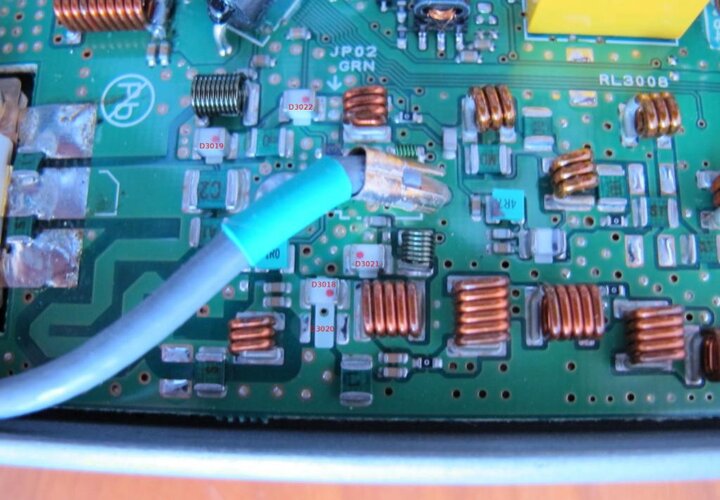
"Dear Sir: I repaired a radio with same similar symptoms. Get a Service Manual. Follow the RF trace from the VHF/UHF finals to two PIN Diodes leading out to the low pass filter section and from there going out to the antenna SO-239. In my case it was the first pin diode, which you can check from the ((((((circuit trace to the diode))))))) and then the diode itself. Mine was not soldered from the factory, but worked for some time before the symptoms appeared. When I touched it with the DVM probe the pin diode went flying over my head. It's a 25 watt pin diode, I replaced it with a 50 watt pin diode. Your SWR intermittent is caused by the Foward/Reflected sensor is seeing the loss of connection through the LPF, and antenna conn. Good Luck"

I have the circuit diagrams. This looks like it may be a bit above what I am able to do. I may open up the case and take a peak to see if I can identify the area of the PA circuit involved.
 

DaveInDenver

Rising Sun Ham Guru
Joined
Jun 8, 2006
Messages
14,120
Location
Grand Junction
He seems to be talking about D3021 & D3019 or maybe D3023 & D3039
 

Attachments

  • ft-857_scaled_PIN.jpg
    ft-857_scaled_PIN.jpg
    93.4 KB · Views: 346
Back
Top