Sure, isolators have some nifty battery health features, but they are by no means necessary to reap benefits of having multiple parallel battery.
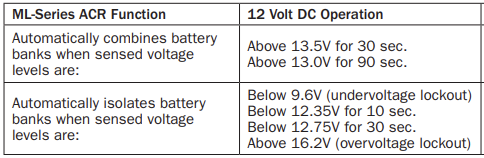
That "switch" combines in 10 or 90 seconds and opens in 10 or 30 seconds.
It is time and voltage based. It simply makes sense to not combine when the start battery is powering the starter and then put some juice into the just-used starter battery first. Nothing to do with state of charge.
Blue Sea MIL ACR Relay Instructions:
https://d2pyqm2yd3fw2i.cloudfront.net/files/resources/instructions/980035700-001-ML-ACRs.pdf

Blue Sea MIL ACR Relay Instructions:
https://d2pyqm2yd3fw2i.cloudfront.net/files/resources/instructions/980035700-001-ML-ACRs.pdf and
https://www.bluesea.com/support/articles/1366/Automatic_Charging_Relay_[ACR]_Explained
An alternator can only do its maximum. If you have one dead car battery on a 100 amp alternator, that alternator will output whatever the battery will accept up to 100 amps. If you have two or 10 dead car battery on a 100 amp alternator, that alternator will output whatever the batteries will accept up to 100 amps.
Just the same above time and voltage based method.
Same as above: An alternator can only do its maximum. If you have one dead car battery on a 100 amp alternator, that alternator will output whatever the battery will accept up to 100 amps. If you have two or 10 dead car battery on a 100 amp alternator, that alternator will output whatever the batteries will accept up to 100 amps.
Undervoltage lockout is 9.6 for Blue Sea ACRs. The point being if a battery only reads 9.5 it is likely damaged and should be treated differently than ordinary charging.
https://www.bluesea.com/support/articles/1366/Automatic_Charging_Relay_[ACR]_Explained
"What does “Undervoltage Lockout” mean? As a safety feature, some ACRs prevent combining into a severely discharged battery. A dual-sensing ACR will monitor the voltage on both batteries and will not connect if either battery is below the undervoltage lockout level. Use caution when combining into a battery with extremely low voltage, because this might represent a faulty battery or a problem elsewhere in the system."



 So the Blue Sea MIL ACR combines based on voltage+time. If volts>13.5 then 30 seconds, volts >13.0 then 90 seconds, and voltage < 13.0 then no combine. I still feel like this is pretty ideal for my real world conditions.