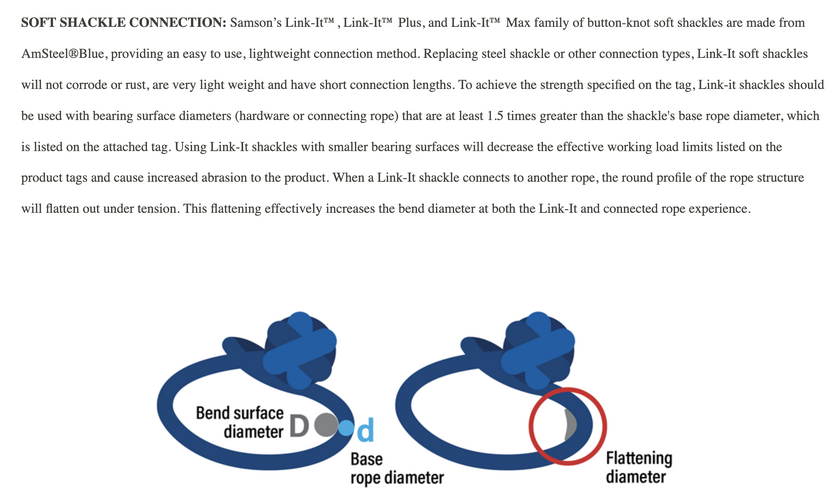
Does the manufacturer give bend radius and de-rating suggestion?
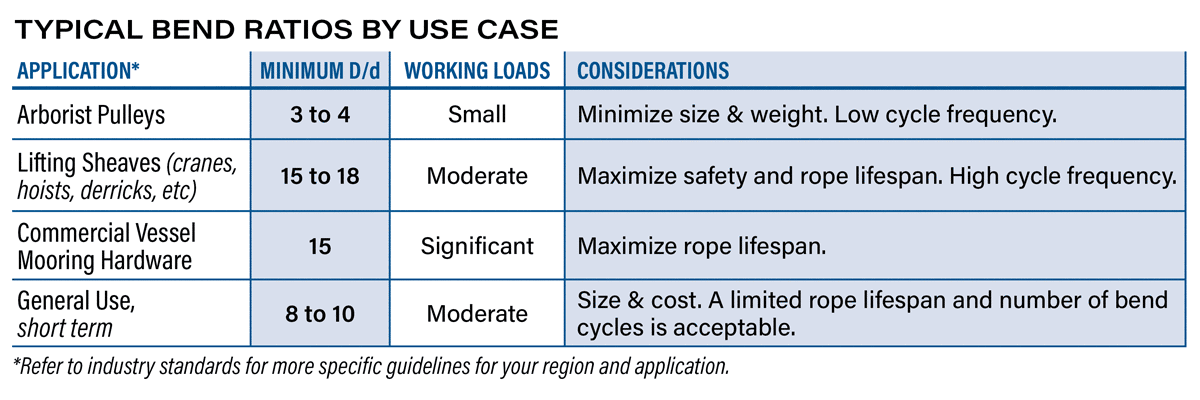
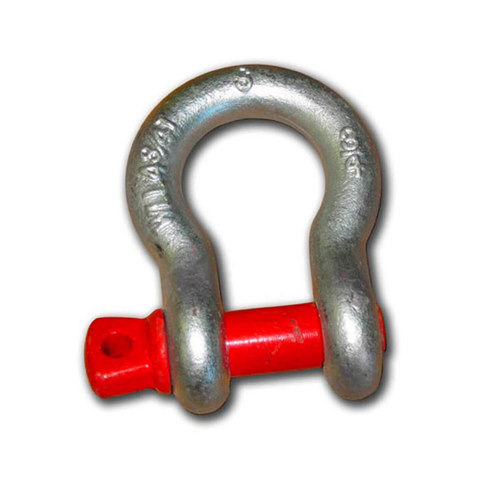
To fit a 7/16" rope in a 2" shackle receiver the rope must bend around a radius of 1.125" in diameter (or tighter since I only assumed 2" minus two 7/16" thicnesses) so a D/d ratio perhaps on the order of 2.5:1, which is tighter than any guidance Samson gives. They suggest an absolute minimum of 3:1 D/d but that isn't necessarily the radius required for the full 100% rating, just tighter than this is never to be used.
4WD use doesn't fall under any use case and there's no agreed upon design margin here but you can see that even a light load requires 3:1 and general use of 8:1 would suggest a diameter of 3.5" for a 7/16" rope. The ratings on most rigging follows the lifting guidelines (e.g. a 3/4" shackle is 4.75 tons because of ASME rules for cranes and such). So using that would suggest a potentially the 15:1 D/d as a starting point.
Samson Product Warning Statement webpage.

www.samsonrope.com
BENDING RADIUS
SIZING THE RADIUS OF BITTS, FAIRLEADS, AND CHOCKS
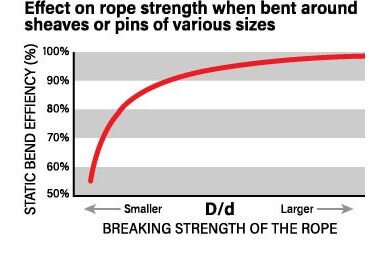
Any sharp bend in a rope under load decreases its strength and may cause premature damage or failure. In sizing the radius of bitts, fairleads, sheaves, and chocks for best performance, the following guidelines are offered: Where a rope is deflected more than 10 degrees around a surface (e.g., bitts or chocks), the effective diameter of that surface should be at least three times the rope diameter. Larger diameters may be required by specific industry guidelines and are better because the durability of the rope increases substantially as the diameter of the surface over which it is worked increases.
For mooring line applications MEG4 recommends a 15:1 D/d ratio.
See Samson's Mooring Manual for additional information.
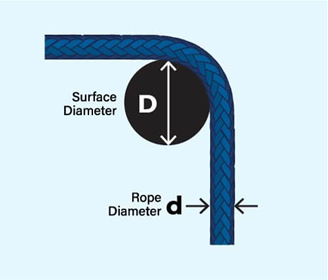 Where a rope bends more than 10 degrees around a surface (e.g., bitts or chocks), the effective diameter of that surface should be at least three times the diameter of the rope.
SHEAVE RECOMMENDATIONS
Where a rope bends more than 10 degrees around a surface (e.g., bitts or chocks), the effective diameter of that surface should be at least three times the diameter of the rope.
SHEAVE RECOMMENDATIONS
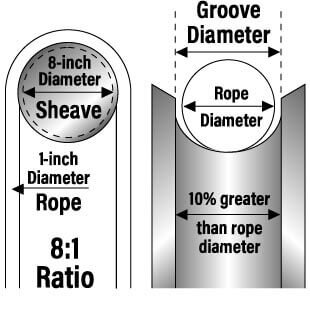
To ensure maximum efficiency and safety, sheaves utilized with ropes should be sized to align with existing industry standards for the specific application. In some cases, static or infrequent operation can allow for relatively low D/d ratios between the diameter of the sheave (“D”) and diameter of the rope (“d”), however as the D/d ratio becomes smaller, the static strength and operational longevity will be reduced. The sheave groove diameter should be no less than 10% greater than the rope diameter. The sheave groove should be round in shape. Sheaves with “V” shaped grooves should be avoided, as they tend to pinch and damage the rope through excessive friction and crushing of the rope fibers. Sheave surfaces should be kept smooth and free of burrs and gouges. Bearings should be maintained to ensure smooth rotation.