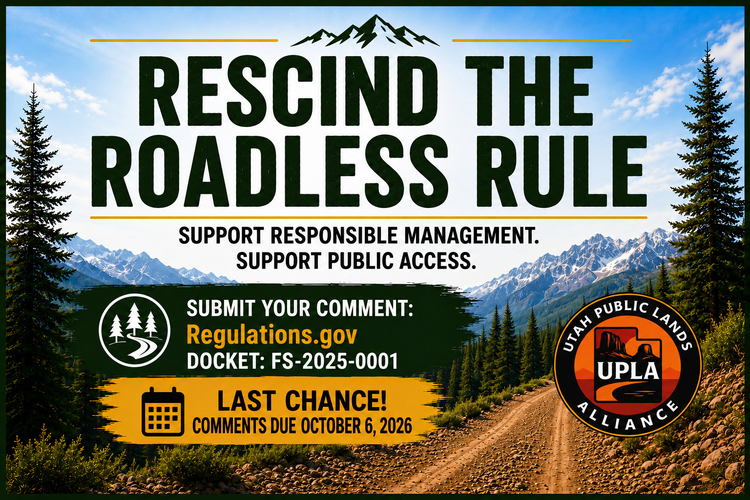
Ok so I asked the ai about this. sorry for wasting all the water but if I share the info maybe we're saving some? TLDR warning...
as someone who likes to go camping and four wheeling, should I be for or against the Roadless Rule?
If you mean the
federal Roadless Rule governing National Forest lands, I’d say
you should probably be conditionally against expanding/strengthening it—but not necessarily against the idea of protecting roadless country.
The key distinction for someone who
camps and four-wheels is that the Roadless Rule is often described as though it simply means “no motorized recreation.”
That isn't actually what the 2001 rule does.
What the Roadless Rule actually does
The 2001 rule protects about
58.5 million acres of Inventoried Roadless Areas by restricting things such as:
- construction of new roads
- reconstruction of roads
- certain timber harvesting
It
does not categorically ban 4x4s, ATVs, or other motorized recreation in those areas. The Forest Service specifically stated that motorized recreation was not being prohibited by the rule, and that existing or future designated trails could still be managed at the local forest level.
That's important for you.
From a four-wheeler's perspective
I'd think about it this way:
| Issue | Roadless Rule | How I'd view it as a 4x4 camper |
|---|
| Protecting remote camping areas |  | Good |
| Preventing unnecessary new roads | | Probably good |
| Protecting wildlife/habitat | | Good |
| Keeping existing legal 4x4 trails open | / | Very important |
| Preventing trail expansion into pristine areas | | Reasonable |
| Blanket prohibition of motorized recreation |  | I'd oppose it |
| Closing established 4x4 routes simply because they're in a roadless area | | I'd strongly oppose it |
| Allowing responsible 4x4 access while protecting the surrounding wilderness | | Best outcome |
There's actually a pretty compelling argument that
you can be pro-roadless conservation and pro-four-wheeling at the same time.
Here's where I think the issue gets interesting for you
If your idea of four-wheeling is
driving an established Forest Service trail to a remote campsite, exploring an old mining road, running a legitimate 4x4 route, and then leaving the place exactly as you found it, I'd be reluctant to support policies that eliminate that access.
But if "opposing the Roadless Rule" means
opening every roadless area to new roads and unrestricted vehicle access, I wouldn't recommend that either.
There's a middle ground that makes a lot of sense:
Protect the land from unnecessary new road construction while preserving responsible motorized access on legitimate existing roads and designated trails.
That is actually pretty close to the distinction the Forest Service made when developing the original rule. The agency explicitly noted that existing/future trails were not subject to the rule's nationwide road prohibitions and that trail decisions could remain at the individual National Forest level.
One particularly important wrinkle if you're in Colorado
Colorado is
not simply governed by the original 2001 Roadless Rule. Colorado adopted its own
Colorado Roadless Rule in 2012, which supersedes the 2001 designations in the state. The Forest Service's current mapping specifically identifies the Colorado rules separately.
So if you're asking this because you've heard about a
current proposal or political fight over changing the Roadless Rule, I'd want to look at the
specific proposal before telling you whether you should support or oppose it. The practical consequences for someone who owns a 4x4 and camps in places like Colorado can be quite different from the general political talking points.
My bottom line for you:
Be pro-conservation, pro-access, and skeptical of blanket restrictions. I'd favor protecting genuinely wild areas while fighting to preserve
legal, established 4x4 routes and dispersed camping access rather than taking an all-or-nothing "Roadless Rule = good/bad" position.
If you'd like, I can also break down
the current 2026 Roadless Rule controversy specifically from a 4x4/off-road enthusiast's perspective—including
what would actually change for you if the current proposal goes through.
Break down the current 2026 Roadless Rule controversy specifically from a 4x4/off-road enthusiast's perspective
Yes. And after looking at the
actual 2026 proposals, I’d make an important distinction from my earlier answer:
For a 4x4 enthusiast, the Roadless Rule repeal itself is less important than the companion 2026 proposal to rewrite the Forest Service Travel Management Rule. The two are happening at roughly the same time, but they affect your recreation in very different ways.
The 30-second version
If I were in your shoes—someone who enjoys
camping, exploring Forest Service roads, and four-wheeling—I would
not automatically cheer the Roadless Rule repeal.
I'd be
cautiously supportive of giving local Forest Service managers more flexibility,
provided that the rules preserve designated 4x4 routes, prevent irresponsible cross-country driving, and don't turn "more access" into a justification for building roads everywhere.
But I would pay
much closer attention to the Travel Management proposal, because that one could directly affect where your vehicle can legally go.
1. What is actually happening?
On August 18, 2026, the Forest Service proposed rescinding the
2001 Roadless Area Conservation Rule.
The proposal would remove the national restrictions that generally limit new road construction and certain timber activities in inventoried roadless areas.
But here's the part that's easy to miss:
It does NOT immediately authorize you to drive your 4x4 wherever you want.
The proposal explicitly says it does not itself authorize specific roads or projects. Existing forest plans, environmental laws and other restrictions still apply. Future road projects would have to go through the applicable planning and environmental processes.
And there's another
very important fact for you:
Colorado is specifically exempt from this particular repeal.
The federal proposal says the
Colorado and Idaho state-specific Roadless Rules remain in effect.
Colorado has approximately
4.2 million acres governed by its own 2012 Colorado Roadless Rule.
So if you're thinking:
"Does this mean they're about to open Colorado's roadless areas to 4x4s?"
No. Not as a result of this proposal.
That's a really important distinction.
2. So why should a Colorado 4x4 guy care?
Because the
other rule being proposed could matter enormously.
The Forest Service is also proposing a major rewrite of its
Travel Management Rule.
That's the regulation that has much more direct control over:
- which roads you can drive
- which trails you can drive
- which areas are closed to motor vehicles
- how motorized routes are designated
- how Motor Vehicle Use Maps (MVUMs) work
- whether certain off-route vehicle use can occur
The current system generally works on a:
basis.
In other words, you look at the MVUM and find the roads/trails designated for motorized use.
The proposed system moves toward:
"Open unless designated closed."
That's a
much bigger deal for a four-wheeler.
3. And here's the part I think you'll find interesting
The proposed Travel Management changes specifically contemplate allowing certain
off-route motorized travel.
Among the examples listed by the Forest Service are:
- dispersed camping
- firewood collection
- retrieving downed big game
The proposal also contemplates greater access to existing roads, trails, trailheads and other access points.
For someone who likes overlanding, that's potentially significant.
Imagine you're driving a legitimate Forest Service route and there's a dispersed campsite 100 yards off the main road.
Under today's system, you can't simply assume:
"It's Forest Service land, therefore I can drive there."
The proposed framework could provide circumstances under which limited off-route motorized access is permitted.
That's potentially good news for your kind of recreation.
But there's a catch.
4. The biggest danger isn't "more roads"
It's
loss of certainty.
The current system gives you something extremely valuable:
The MVUM.
If the road is shown as open to your vehicle, you've got a pretty good answer.
If it isn't, you shouldn't drive it.
The Forest Service's current data system explicitly identifies which roads and trails are designated for motorized vehicles and the types of vehicles and seasons permitted.
That's actually a pretty good system for responsible four-wheelers.
The proposed "open unless closed" approach could make things more complicated.
A route may physically exist.
Aerial imagery might show it.
Someone might have driven it for decades.
But that
doesn't automatically mean it's legally part of the Forest Service transportation system or legally open to your vehicle. The proposal itself acknowledges that distinction.
So I would
not interpret the proposal as:
"Every old jeep road is now legal."
It isn't.
5. Here's where I think the 4x4 community has a legitimate reason to be excited
The Roadless Rule has historically made certain types of forest management more difficult.
The Forest Service argues that rescinding the national rule would give local managers more flexibility to:
- construct strategic roads
- conduct fuels treatments
- improve fire suppression access
- manage forests
- provide additional public access
The agency says more than 40% of inventoried roadless areas have high or very high wildfire hazard potential.
From a four-wheeler's perspective, there's a reasonable argument here:
A healthy forest needs active management, and strategically placed roads can sometimes serve both management and recreation.
For example, a road built primarily to facilitate forest management could eventually provide:
fire access → forest management → public access → dispersed camping → recreation
That's not necessarily a bad outcome.
6. But here's the argument against repeal
There is a very legitimate counterargument.
Once you build a road, you're not just creating a line on a map.
You're creating:
- vehicle access
- human access
- camping pressure
- hunting pressure
- development pressure
- potential OHV expansion
- invasive species pathways
- erosion
- maintenance obligations
And the Forest Service already has a huge road-maintenance backlog.
The federal proposal itself acknowledges a roughly
$6.9 billion deferred maintenance backlog for roads and bridges.
So the question I'd ask isn't:
"Can we build more roads?"
I'd ask:
"Which roads are worth building and who is going to maintain them?"
That's a much better question.
7. And there's another issue I'd be concerned about as a 4x4 enthusiast
The possibility of turning good trails into bad trails.
This may sound counterintuitive, but
unlimited access isn't necessarily good for off-roading.
Take a really good two-track trail.
Today:
- relatively limited traffic
- manageable erosion
- good camping experience
- wildlife still uses the surrounding country
- Forest Service can manage it
Then suddenly it's easy to access.
Traffic increases.
People start creating bypasses.
Someone gets around a mud hole.
Someone drives around a closed gate.
Someone creates another campsite.
Then another.
Eventually the Forest Service has a problem.
And the response can be:
CLOSE THE WHOLE AREA.
That's something responsible 4x4 enthusiasts should be very concerned about.
8. This is why I'm actually more supportive of managed access than unrestricted access
If you asked me to write a policy specifically for people like us, I'd want something like this:
 Keep
Keep
Existing legal 4x4 routes
If it's an established Forest Service route and it's environmentally sustainable, keep it open.
Expand selectively
Create new routes where they make sense.
Especially routes that:
- provide legitimate recreation
- improve emergency access
- facilitate forest management
- connect existing routes
- reduce concentrated traffic elsewhere
Encourage
Designated dispersed camping access
If there's a durable campsite that can handle vehicle access, let people drive there.
Preserve
Remote areas that are genuinely valuable because they're remote.
Not every acre of Forest Service land needs a Jeep trail.
 Stop
Stop
User-created trail proliferation.
This is where I think the 4x4 community needs to police itself.
Stop
Driving around gates and closures.
Nothing gets legitimate trails closed faster.
9. What I would NOT want
I would
not want:
"Everywhere is open unless somebody manages to close it."
That sounds fantastic to an off-roader initially.
But imagine 10 years later.
Every popular mountain has:
- side trails
- bypasses
- illegal campsites
- erosion
- trash
- conflicts with hunters/hikers
- damaged wetlands
Then the Forest Service has to react.
And politicians start hearing:
"OHVs are destroying the forest."
And suddenly
your legitimate 4x4 trail is at risk.
That's not a good long-term strategy for the off-road community.
10. Where Colorado is especially interesting
This is where I'd separate
your Colorado interests from the national debate.
The 2026 Roadless Rule repeal
doesn't repeal Colorado's Roadless Rule.
Colorado's rule remains in place and covers roughly
4.2 million acres.
So if you're primarily concerned with places like the:
- Arapaho
- Roosevelt
- Pike
- San Isabel
- White River
- Routt
- San Juan
- Rio Grande
- Grand Mesa/Uncompahgre/Gunnison
you shouldn't assume the August 2026 federal announcement suddenly changes your access.
It doesn't.
Your
existing travel-management designations and MVUMs remain much more important to your day-to-day four-wheeling.
11. My scorecard for you
If I put myself in the mindset of a person who owns a capable 4x4 and likes
exploring rather than just driving to developed campgrounds, I'd rate the proposals this way:
| Policy change | My 4x4 score |
|---|
| Repeal national 2001 Roadless Rule | +1 |
| More local Forest Service discretion | +2 |
| Strategic new roads | +2 |
| Better wildfire access | +2 |
| More dispersed camping access | +3 |
| Limited legitimate off-route access | +2 |
| "Open unless closed" concept |  +1 / −1 +1 / −1 |
| Uncontrolled user-created trails | −3 |
| Building roads simply because we can | −3 |
| Losing clear MVUM guidance | −3 |
| Weakening environmental/trail protections too far | −3 |
So I'm
not a hard "repeal it!" guy.
I'm more:
"Give local managers the flexibility to provide more legitimate access—but don't confuse access with unrestricted access."
12. And there's a REALLY important timing issue
As of
today, October 5, 2026, the Roadless Rule proposal is
still a proposal, not a completed repeal.
In fact, USDA just extended the public-comment deadline from September 21 to
October 6, 2026.
So
you still have an opportunity to comment.
And if you're going to comment as a 4x4 enthusiast, I would
not simply write:
I'd write something much more sophisticated:
Support responsible motorized access, maintain sustainable designated routes, expand legitimate dispersed-camping opportunities, preserve high-value remote areas, and give local Forest Service managers the authority to balance recreation, wildfire management, and resource protection.
That's a position I think would be much harder to dismiss as simply "an OHV advocate wanting more trails."
One more thing I'd strongly recommend
Don't focus all your attention on the Roadless Rule.
If your primary concern is
four-wheeling, the
2026 Travel Management Rule proposal may actually be the more consequential issue for you. It directly addresses motorized access, MVUMs, off-route travel, existing roads and trails, and how future access decisions are made.
And there's an interesting irony here: the Forest Service's proposed approach could
increase motorized access, but it could also create more uncertainty about which routes are actually legal and potentially increase conflicts between users. That's why I'd want to evaluate the two proposals
together, rather than treating "Roadless = anti-4x4" and "repeal = pro-4x4."
If you'd like, I can go one step further and
tell you exactly how I would vote/comment on each of the 2026 proposals if I were a Colorado 4x4 enthusiast—and give you a short, fact-based comment you could submit to the Forest Service.
Tell me exactly how you would vote/comment on each of the 2026 proposals if you were a Colorado 4x4 enthusiast and give me a short, fact-based comment I could submit to the Forest Service
Yes. If I were a Colorado-based 4x4 enthusiast who values both access and keeping great public-land country intact, I would take a qualified-support position on one proposal and a more cautious/supportive-with-changes position on the other.
The two proposals should not be treated as the same thing.
My recommendation
2026 proposalWhat I'd doWhyRescind the national 2001 Roadless Rule — RIN 0596-AD66Support, but with conditionsMore local flexibility can improve forest management, wildfire mitigation and legitimate recreation access. Colorado's separate Roadless Rule remains in effect.Rewrite Travel Management Rule — 36 CFR Parts 212/261Support the access objective, but request important safeguardsThis proposal has the greatest direct potential impact on your four-wheeling. It creates a presumption favoring access and allows more flexible changes to roads/trails, but needs clear mapping, public notice and protection against arbitrary closures or route proliferation.
1. Roadless Rule: I'd say YES—but not "open everything."
The proposed rescission would remove the national 2001 restrictions on road construction, reconstruction and certain timber activities in inventoried roadless areas and return much of that decision-making to individual forests.
For me, that's reasonable.
But I'd specifically tell the Forest Service:
Don't interpret this as a mandate to build roads.
Instead:
Give local managers the authority to decide where roads make sense based on wildfire risk, forest health, emergency access, recreation and environmental conditions.
That's a much better policy than either extreme.
And there's an especially important Colorado point: the Colorado Roadless Rule is not being repealed by this proposal. The 2026 proposal expressly says the Colorado and Idaho state-specific rules remain in effect.
So I wouldn't make my comment about "opening Colorado roadless areas." That would be factually wrong.
I'd make it about responsible local decision-making and maintaining legitimate motorized access.
2. Travel Management Rule: this is the one I'd watch VERY closely
This is potentially much more consequential to you as a four-wheeler.
The Forest Service is proposing a new national access framework with a presumption that existing roads, trails, trailheads and other access points are open to appropriate public use unless there is a legally supported reason to restrict them.
That's a significant philosophical change.
Instead of:
"We have to designate this route as open."
the proposed approach moves toward:
"This existing route is presumed open unless there's a reason to close or restrict it."
As a 4x4 enthusiast, I like the basic idea.
But I would insist on three things.
A. Keep good MVUMs
I don't want the answer to become:
"The road physically exists, so I can drive it."
The proposal itself recognizes that aerial imagery or evidence that a physical route exists doesn't automatically establish that it's part of the Forest Service transportation system, that the Forest Service has jurisdiction, or that it's open to a particular use.
That's good.
I'd tell them:
Give us clear, current maps showing exactly what is legal.
That's better for the Forest Service and responsible off-roaders.
B. Don't make closure decisions arbitrary
The proposal gives managers considerable discretion to restrict access based on resource conditions, public safety, conflicts among uses and maintenance/administrative capacity.
I agree with those factors.
But I'd ask for:
documented justificationpublic noticean opportunity for public input on significant closuresperiodic reviewclear signage on the ground
That's particularly important because "maintenance capacity" shouldn't become a permanent justification for closing a route that people have legitimately used for years.
C. Keep legitimate dispersed-camping access
This is one area where I'd be quite supportive.
The proposal specifically contemplates limited off-road motor-vehicle use for purposes including dispersed camping and retrieving downed big game, among others.
For someone who actually uses a 4x4 to get into the backcountry, that's a very meaningful change.
I'd support that where the site is durable and the use isn't causing resource damage.
So what would my actual position be?
I'd phrase my overall philosophy like this:
More access, not unrestricted access.More local decision-making, not less accountability.More legitimate 4x4 opportunities, not uncontrolled cross-country driving.Protect the places that are special because they remain wild.
I think that's a very defensible position for a Colorado off-roader.
The comment I'd actually submit
Because the Forest Service specifically asks commenters to explain the reason for their recommendation and, where possible, identify the relevant proposal/sections, I'd keep it substantive rather than writing a political rant.
Roadless Rule — RIN 0596-AD66
Roadless Rule CommentI support the Forest Service's proposal to rescind the national 2001 Roadless Area Conservation Rule and return management decisions to local Forest Service officials.As a recreational four-wheel-drive user and camper who values access to our National Forests, I believe local managers are better positioned to balance recreation, wildfire mitigation, forest health, wildlife habitat, and resource protection than a single nationwide restriction.I support responsible road construction and maintenance where it provides meaningful benefits such as wildfire mitigation, emergency access, forest health, or legitimate public recreation. However, rescinding the national rule should not be interpreted as a mandate to build roads simply because construction is permitted.I also encourage the Forest Service to preserve and improve legitimate motorized recreation opportunities, including established four-wheel-drive routes and appropriate access to dispersed camping, while protecting areas whose value depends on remaining relatively undeveloped.The goal should be responsible access and active stewardship—not unrestricted vehicle use. I encourage the Forest Service to retain strong enforcement against unauthorized cross-country travel and user-created routes while giving local managers the flexibility to expand sustainable public access where appropriate.I believe this approach would better serve both the public and the long-term health of our National Forests.
That is the one I'd submit.
It supports the proposal without handing the Forest Service a blank check.
And I'd submit a separate comment on Travel Management
This one I'd make more strongly pro-access, because that's where I think your interests line up particularly well with the proposed change.
Travel Management Rule CommentI support the Forest Service's proposed shift toward an access-oriented travel-management framework that increases public access to National Forest System lands and gives local managers greater flexibility to respond to changing conditions.As a recreational four-wheel-drive user and camper, I particularly support maintaining and expanding legitimate access to existing roads, trails, trailheads, and appropriate dispersed camping locations.I encourage the Forest Service to ensure that the final rule provides clear and current Motor Vehicle Use Maps and on-the-ground signage so that responsible motorized users can easily determine where vehicle use is permitted. The existence of a physical route should not automatically authorize motorized use, but the public should have a clear and reliable way to distinguish legal routes from unauthorized user-created routes.I also support allowing limited off-route motorized access for legitimate purposes such as accessing appropriate dispersed campsites, provided that resource conditions and site durability can support that use.At the same time, I encourage the Forest Service to require documented justification, public notice, and periodic review for significant road or trail closures. Maintenance limitations should not automatically result in permanent loss of legitimate public access when a route can reasonably be maintained or managed.I support responsible motorized recreation and believe that increased access and responsible resource protection can coexist. The final rule should promote legal, sustainable four-wheel-drive access while continuing to discourage unauthorized cross-country travel and resource damage.
That's the one I'd be particularly enthusiastic about.
The Travel Management proposal explicitly says the new framework is intended to increase public access, while retaining legally required protections and local decision-making.
One thing I'd change if you want to make the comment more powerful
I'd add your personal experience.
The Forest Service doesn't need another generic "I support 4x4 access" comment. A short statement from an actual person who uses these lands is more compelling when it explains how the land is used and why access matters.
For example:
"I use my four-wheel-drive vehicle to reach dispersed campsites, explore established forest routes, and experience remote areas that I could not otherwise access."
Then add something about why you value leaving those places in good condition for the next person.
That turns this from a political statement into a credible recreation-user comment.
One timing point
The Roadless Rule comment period was extended and closes October 6, 2026, so if you want to submit that one, I'd do it now. The Forest Service says comments should reference RIN 0596-AD66 or docket FS-2025-0001.
Submit the Roadless Rule comment through Regulations.gov
If you want, I can also turn these into one very concise, 150–200-word comment written in your own voice as a longtime camping/4x4 enthusiast, rather than sounding like a lawyer or environmental-policy expert.
now I just need to make time to read all that...