Fuel tank tech

ScaldedDog

Hard Core 4+
Joined
Dec 18, 2005
Messages
1,326
Location
Sedalia, CO/NSB, FL
I'm trying to get my 4Runner's gas gauge to work better, and have a question: How deep should the float and sensor sit in an empty tank? Here's what an '88 4Runnner's sender assembly looks like:

20250121_085836.jpg


Does the low fuel sensor need to touch the bottom of the tank, or does it sit up off the bottom? At what point does the sensor detect that it is no longer sensing fuel? (e.g. When the top of it is exposed? When none of it is touching fuel?) For reference the sensor is exactly 1" "tall", and 1g of gas would take up roughly 3/4" at the bottom of the tank. (Tank bottom is roughly 10x30, and 1g of fluid is 231 cubic inches, so 231/300=.77") If I could set it up so that on level ground the light comes on and the gauge shows empty with 2g remaining I'd consider it perfect, but it certainly doesn't have to work that way. It would be nice if it came on and showed empty before the motor quit, though.

Second question: Do these Toyota floats ever become saturated and stop floating? I had that happen once on, IIRC, a '74 Pinto, but didn't know how likely it was on something more modern. (Yeah, I know, it's an '88...) How deep do they sit in fuel when working correctly?

All this matters because I swapped the stock 17g tank for a 14.7g one a few years ago. The only difference between the two is the smaller tank is 3/4" shorter, and I needed the clearance more than I needed the fuel. I can't remember what, if anything, I did to the sender then, but the gauge has never been very accurate since, and I have the opportunity to fix it now.

Mark
 

ScaldedDog

Hard Core 4+
Joined
Dec 18, 2005
Messages
1,326
Location
Sedalia, CO/NSB, FL
Come on, guys, slow down. I can only read one response at a time... :ROFLMAO:

I knew this was a bit of a goofball question, but thought someone may have fooled with these things. I'll amend my question to something I know folks here will know:

Is there any danger in turning on an in-tank fuel pump in an empty, or nearly empty, tank? I'd just as soon not immolate myself at the turn of a key.

My plan is to shorten the sensor arm slightly, to put it in the same position relative to the tank bottom as it was with the larger tank, and reinstall the tank in the vehicle. I'll check the gauge and light status with the tank empty, then add one gallon at a time between other tests up to 5g, or so. That'll let me understand how the gauge and light work at low fuel levels. I don't have to hook up the fuel pump while doing this - the connections to the sensor and pump are separate - so the question above is what happens if I forget and do so?

Mark
 

60wag

Rising Sun Member
Joined
Aug 23, 2005
Messages
2,717
No real help here other than, would it make sense to do the testing with water rather than gasoline? The float might sit at a slightly different level than in gas but likely not enough to make a difference.
 

Pz10420

Hard Core 4+
Joined
Jun 21, 2020
Messages
674
I didn't read through all the details of your post but I would use a multimeter to measure the resistance range as you move the float back and forth. That will pretty much tell you where the float reads that the tank is in theory empty. Although I am sure Toyota has a safe guard of fuel in the bottom of the tank when the gauge reads zero.
 

DaveInDenver

Rising Sun Ham Guru
Joined
Jun 8, 2006
Messages
14,344
Location
Grand Junction
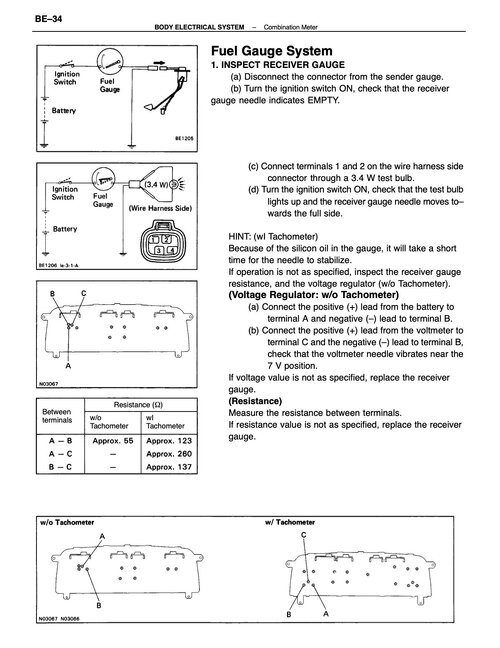
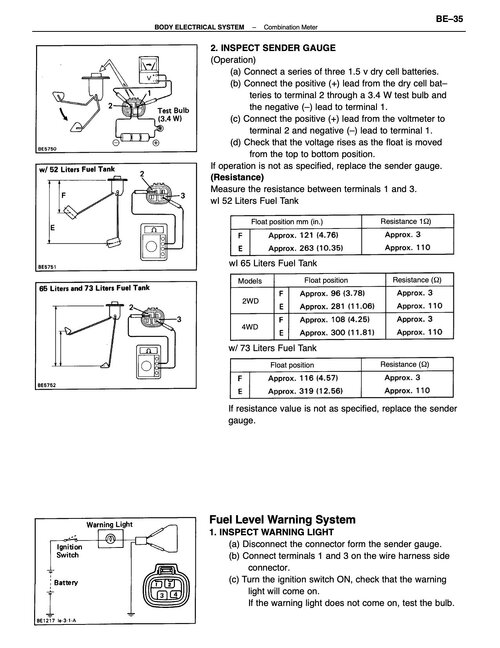
Here's the 89-95 specs, I wouldn't bet against the 84-88 being basically the same thing functionally. The arms might not be the same. For the 3rd gens tanks were 52L (14 gal), 65L (17 gal) and 73L (19 gal). The range of resistances is the same so it would seem the room for the arm to swing is the key. The longer the arm the more precise the measurement will be, too.

Looks like the mounting flange is zero and center of mass of the float is reference. That makes sense, floats (and for that matter ships and swimmers) sit in the liquid and displace it, not on top.

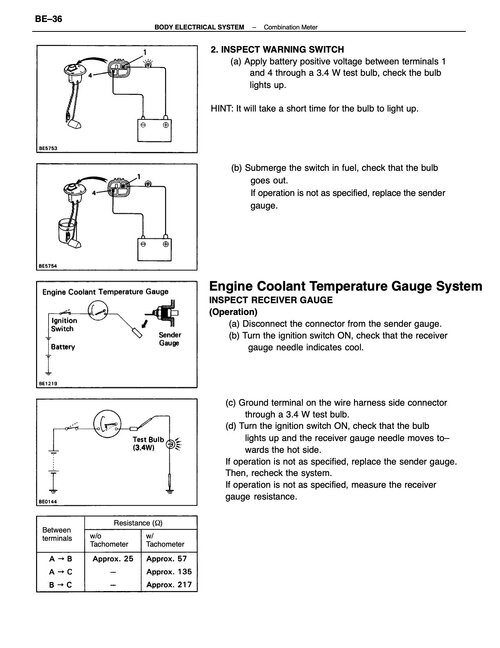
It would seem like the low fuel switch would be held slightly above the bottom otherwise that rod would wear on the tank wall. If I was guessing the end of the support will be the same as the bottom of the float when it's fully swung down. As I recall you had to really worry when the low fuel light comes on, that means you're really out. Now that I think about it, this is also why you can run the fuel gauge to way below empty before the light comes on. There's going to be a difference of half the float thickness between the two measurements, which could mean a gallon or two.

It would be tempting to use water but I'd think on that first. These parts are not intended to see water so I'd wonder if completely submerging could actually harm them. I don't know either way, just wondering out loud. Gasoline as I recall is an electrical insulator. Pure water also an insulator but it can have impurities (like salt) in it that it will become conductive. As a result they don't have to seal electricals on the fuel pump, switch or sender normally but they might have to in the presence of water. The float shouldn't care, though.

I'd probably not run the pump very long in the air without fuel flowing, it will heat up. Just checking it briefly dry, I dunno, that seems OK. 🤷‍♂️

6combinat_be34.jpg

6combinat_be35.jpg

6combinat_be36.jpg
 
Last edited:

ScaldedDog

Hard Core 4+
Joined
Dec 18, 2005
Messages
1,326
Location
Sedalia, CO/NSB, FL
You guys rock.

I took the fuel pump assembly out and was able to see that the sensor was already about 3/4" off the bottom of the tank, but the float barely kissed the inside of the tank when hanging freely. A quick bend of that arm fixed that.

I thought about the water idea, too, but I think I'll just do my initial tests with the fuel pump connector unplugged. Then I should know how the gauge and light behave when stone cold empty, and with 1g, 2g..., 5g. Once I have 5g in the tank, I'm not concerned about the pump igniting fumes in the tank, if that's even a thing.

You can't see much, but here's a photo of the float and sensor taken through the fuel pump hole, and another one of the fuel pump showing the shortened mounting frame, which I had to do when I swapped tanks a few years ago.

20250122_085703.jpg


20250122_085744.jpg


Mark
 

Rzeppa

Rising Sun Member
Joined
Aug 24, 2005
Messages
9,019
Location
Kittredge CO, USA
On a 40, the float is closed cell foam, so it can't sink like a hollow one that had a leak could. Pretty sure the float in the carb is the same stuff.
 

ScaldedDog

Hard Core 4+
Joined
Dec 18, 2005
Messages
1,326
Location
Sedalia, CO/NSB, FL
Under the category of "let's post data on the internet that is absolutely inapplicable to anyone else", I'm pretty pleased with the way this turned out. By adding a gallon at a time and then turning the key to "on" for a few minutes after each add, I was able to confirm:

F = 12g
3/4 = 10g
1/2 = 7.5g
1/4 = 5g
E = 2g

Assuming this holds in real life - and it may very well not - that's about as linear as I've seen, and way better than the gauge on my tow rig. Interestingly, at just the top edge of the E mark it has 3g, but the gauge doesn't move below E, even with zero gas in the tank. So E means there's 2g of "reserve", but I suspect that worthless in a crawler.

The only bad thing I noticed is that the low fuel light never came on, at all. I don't know if the sensor is bad, or the bulb is dead, or something else. It doesn't matter, other than the fact that I figure if something exists it should work, and this doesn't.

The only other thing to figure out is how much more fuel I can get in the tank before the pump clicks. The tank is nominally 14.7g, or 14g, if Dave's number above is correct, but I don't know if either of those numbers represent usable capacity, or just the mathematical volume of the tank. That test will have to wait, though, as my rear axle is spread all over the front range getting broken or screwed up stuff fixed.

Thanks for indulging me on this.

Mark
 
Back
Top